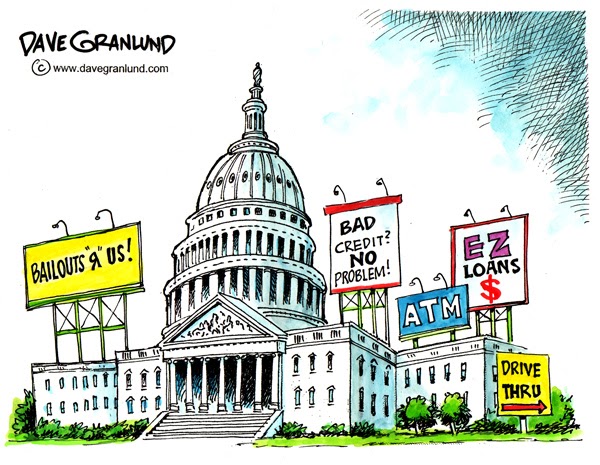
"Our Children and Grandchildren are not merely statistics towards which we can be indifferent" JFK
Showing posts with label Deficit. Show all posts

Monday, July 25, 2011

The (Cuisan)art of fiscal policy (Paul Daggett)

Puréeing: Flawed ideas and denial
result in mush that no one can swallow.

StarTribune
July 24, 2011
By: Paul Daggett

The continuing stalemate over whether to raise the debt ceiling and how to control the nation's budget deficits is revealing. Politicians are unable or unwilling to acknowledge the seriousness of the U.S. fiscal position.

Consider the central disagreement between the parties: taxes. The Republican Party opposes increases of any kind, saying that taxes on "job creators" are exactly the wrong policy at a time of high unemployment. To reduce budget deficits without raising taxes, Republicans propose major cuts in government spending.

Democrats contend the huge cuts required to reduce deficits without "revenue increases" would decimate the lower and middle classes, which are more dependent than ever on government's safety-net programs. They argue that higher taxes on the wealthy are a fair way to balance government budgets.

Unfortunately, both parties' positions are fundamentally flawed.

The Republican position that tax increases would destroy jobs fails to acknowledge that spending cuts would also destroy jobs. Cutting government spending destroys the jobs of government employees as well as the jobs of those who sell goods and services to the government and to the recipients of government benefits.

Many Democrats insist that everything was fine with the budget under President Bill Clinton -- the federal government ran a budget surplus in the final three years of Clinton's second term. Undo the Bush tax cuts for the wealthy and end his expensive wars, and everything should be fine, they say.

Clinton's surpluses, however, were the result of a temporary surge in tax revenue as the Internet bubble inflated, not fiscal responsibility.

More important, these arguments both miss the larger point -- the financial/housing crisis and the Great Recession have changed everything.

The crisis has had enormous impact on the federal budget. The various stimulus plans, bailouts, tax incentives, etc., passed in response to the Great Recession cost far more than the Afghanistan and Iraq wars combined. And while federal spending surged at an unprecedented rate, government revenue was collapsing. Federal tax revenues plunged $400 billion from 2008 to 2009 and failed to recover, remaining level in 2010. Federal government revenues were lower in 2010 than they were in 2000!

Prior to the Great Recession, maybe the government's debt problem could have been solved with some reductions in the major entitlement programs, cuts in war spending and tax increases on the wealthy. But now, even the most "austere" proposals for dealing with the budget crisis (such as those from Rep. Paul Ryan or Obama's deficit commission) do not come close to balancing the budget. They simply slow the pace at which the nation hurtles into debt.

It seems unlikely, in the current political climate, that the United States will take the necessary steps to restrain its profligate ways voluntarily, but at least the country still has the time and resources to do so. Greece, Ireland, Portugal (and now likely Italy) failed to get their budgets under control fast enough and effectively went bankrupt. Now the budget decisions for those countries are dictated by their financial patrons, the European Union and the International Monetary Fund.

So while parties wrangle over whether the wealthy should endure a small tax increase or federal spending should actually be reduced for the first time in most Americans' lifetimes, soon enough the topics of debate will be far more serious:

Should Social Security and Medicare be drastically reformed or eliminated? Should taxes be raised significantly -- and on everyone? How should the United States adapt, geopolitically, to a dramatically downsized military?

The nation's debt will require real sacrifice and tough decisions. America can make those decisions itself or, like Greece, Ireland, and Portugal, leave them to foreign creditors.

Isn't it time the nation's politicians
started taking this seriously?

Paul Daggett is an investment analyst in Minneapolis.

Monday, June 27, 2011

Senator Bernie Sanders: Letter to President Obama (Sacrifice Sharing)

June 27, 2011
Dear Mr. President,

This is a pivotal moment in the history of our country. Decisions are being made about the national budget that will impact the lives of virtually every American for decades to come. As we address the issue of deficit reduction we must not ignore the painful economic reality of today -- which is that the wealthiest people in our country and the largest corporations are doing phenomenally well while the middle class is collapsing and poverty is increasing. In fact, the United States today has, by far, the most unequal distribution of wealth and income of any major country on earth.

Everyone understands that over the long-term we have got to reduce the deficit -- a deficit that was caused mainly by Wall Street greed, tax breaks for the rich, two wars, and a prescription drug program written by the drug and insurance companies. It is absolutely imperative, however, that as we go forward with deficit reduction we completely reject the Republican approach that demands savage cuts in desperately-needed programs for working families, the elderly, the sick, our children and the poor, while not asking the wealthiest among us to contribute one penny.

Mr. President, please listen to the overwhelming majority of the American people who believe that deficit reduction must be about shared sacrifice. The wealthiest Americans and the most profitable corporations in this country must pay their fair share. At least 50 percent of any deficit reduction package must come from revenue raised by ending tax breaks for the wealthy and eliminating tax loopholes that benefit large, profitable corporations and Wall Street financial institutions. A sensible deficit reduction package must also include significant cuts to unnecessary and wasteful Pentagon spending.

Please do not yield to outrageous Republican demands that would greatly increase suffering for the weakest and most vulnerable members of our society. Now is the time to stand with the tens of millions of Americans who are struggling to survive economically, not with the millionaires and billionaires who have never had it so good.

Senator Bernie Sanders


Sanders Says Stand Up to Schoolyard Bullies

Saturday, May 14, 2011

Debt Ceiling...? We Are Already Defaulting (Jacob Hornberger)

By: Jacob Hornberger
The Future of Freedom Foundation
May 11, 2011

The doomsday crowd claims that the sky will fall in if Congress fails to raise the debt ceiling. If the ceiling isn't raised, they say, the federal government will be forced to default on its debt payments, which apparently will then cause the sky to fall in.

That's, of course, ridiculous. For one thing, just because the federal government isn't permitted to add to its ever-soaring mountain of debt doesn't mean that it will be forced to default on debt payments. With the $2.2 trillion it collects in tax revenues, it can give first priority to debt payments.

But let's assume there is a default. Will the sky fall in, as the doomsayers claim?

Not likely. After all, thanks to the Federal Reserve, the federal government is already defaulting on its debts – and has been for decades.

While the ostensible purpose of the Federal Reserve is to “stabilize” the money supply, its real purpose is to enable public officials to spend as much money as they want by borrowing it and then letting the Federal Reserve pay off its creditors with newly printed, debased, cheapened, devalued dollars.

That's precisely what the Fed is doing now, has been doing recently, and has been doing ever since it was established in 1913. It “monetizes” the government's debt by printing the money to pay it off. The inflated supply of money cheapens the value of the money in circulation, which means that bondholders are being repaid in currency that is worth less than it was when they loaned it.

That's a default.

Let's assume I loan the government $1,000 at 10 percent interest, with the note payable one year from now. The year passes. The government owes me $1,100. The government doesn't have the money to pay me because all of its tax revenues are devoted to welfare and warfare, which the big spenders in Congress are dead-set on continuing.

The members of Congress are reluctant to raise taxes to pay me back for two reasons: one, they know that overtaxed people get upset over more taxes, and, two, they're concerned that more taxes will kill the private sector that funds the welfare-warfare state

No problem. The big spenders simply turn to the Fed to do the dirty work for them. The Fed cranks up the printing presses and starts printing large quantities of new money to pay me and the other creditors whose debts are now due.

The government sends me its newly printed $1,100 to pay off my debt. But there is one big problem: That $1,100 now only buys 90 percent of what it used to. Due to the Fed's expansion of the money supply, the dollar has been debased or devalued by, say, 10 percent.

The government has not complied with its promise to pay me $1,100. It has instead paid me in money now worth $990.

That's a default because the government isn't paying me what I am owed.

That's what the Fed has been doing for decades. That's why the dollar is worth about 5 percent of what it was worth in 1913, when the Fed was established. Decade after decade, the Fed has expanded the money supply to accommodate the big spenders in Congress (and the big-spending President), thereby debasing and devaluing the currency. Throughout most of that time, the government's creditors have been paid off in cheapened, debased, devalued dollars.

While decades of continuous default have brought monetary chaos, the sky has never fallen in.

Needless to say, the big spenders in Congress love the Fed. They know that they can keep spending and borrowing to their hearts' content and not have to incur voter wrath by raising taxes. They know that the Fed will always come to their rescue by printing the money to pay for their big spending and big borrowing.

The citizens, of course, have no idea what is occurring. All they see is soaring prices (initially gold, silver, oil, gasoline, and other commodities, and, later, retail prices in general). Unaware that the government itself – through the Fed – is the culprit, the citizens blame the rising prices on greed, speculation, the banksters, the profiteers, the capitalists, the middle men, the entrepreneurs, and perhaps even the illegal aliens.

Our American ancestors had it right. That's why they lived for more than 100 years with no Federal Reserve and no welfare-warfare state and a way of life based on economic liberty, sound money, private property, the free market, and a limited-government, constitutional republic.

Jacob G. Hornberger is founder and president of The Future of Freedom Foundation. He is a regular writer for the Foundation's publication, Freedom Daily, and is a co-editor or contributor to the eight books that have been published by the Foundation.

Originally published on April 29, 2011 at CampaignForLiberty.com. Jacob G. Hornberger, the Future of Freedom Foundation, and Campaign for Liberty are not affiliated with Euro Pacific Capital, Inc. Euro Pacific Capital does not guarantee the accuracy and completeness of third-party authored content.

The commentary above is for the benefit of our readers from opinion makers and writers not associated with Euro Pacific. Opinions expressed are those of the writer, and may or may not reflect those held by Euro Pacific, or its president, Peter Schiff.


Tim Geithner Antsy to Crank Up Money Printing Machines

"A default would inflict catastrophic,
far-reaching damage on our Nation's
economy, significantly reducing growth,
and increasing unemployment."


The Wall Street Journal
By: Damian Paletta
5/14/2011

WASHINGTON—Treasury Secretary Timothy Geithner warned in a letter to Congress that failure to raise the $14.294 trillion debt ceiling would drive up interest rates, push down household wealth, put more pressure on federal entitlement programs and cause a double-dip recession.

Mr. Geithner's letter to Sen. Michael Bennet (D., Colo.), sent Friday, marked one of the Obama administration's most explicit warnings about the consequences of failing to raise the debt ceiling. The U.S. government is projected to hit the ceiling Monday. Treasury officials say they have until Aug. 2 before the country could begin defaulting on its debt.

Some Republicans have questioned whether the Treasury would allow a default to occur, but Mr. Geithner said in the letter that "failure to raise the debt limit would force the United States to default on these obligations, such as payments to our service members, citizens, investors, and businesses."

"This would be an unprecedented event in American history," he wrote. "A default would inflict catastrophic, far-reaching damage on our Nation's economy, significantly reducing growth, and increasing unemployment."

Republicans leaders have said they want to raise the debt ceiling but only if the White House agrees to accompany its major spending cuts. House Speaker John Boehner (R., Ohio) has said it would be "irresponsible" to let the U.S. default, but "it would be more irresponsible to raise the debt ceiling without simultaneously taking dramatic steps to reduce spending and reform the budget process."

The White House and Republicans have begun deficit-reduction talks. Early signs of progress were reported last week, but they haven't reached an agreement and talks aren't expected to pick up again until June. Policy makers have discussed ways to reduce the deficit from what it would otherwise be by close to $4 trillion over 10 years.

Mr. Geithner, Federal Reserve Chairman Ben Bernanke and other government officials have warned for months about the consequences of defaulting on the country's debt. Because the U.S. government is projected to run a $1.5 trillion deficit in fiscal year 2011, it must borrow to cover its obligations unless it makes huge spending cuts or enacts giant tax increases. To borrow, the government issues debt to investors, but it is much harder to issue debt once the country hits the debt ceiling.

A default would make it more expensive for the U.S. to borrow money by selling Treasury securities, Mr. Geithner said, and this would have wide repercussions.

"Treasury securities set the benchmark interest rate for a wide range of credit products, including mortgages, car loans, student loans, credit cards, business loans, and municipal bonds," Mr. Geithner wrote. "Accordingly, an increase in Treasury rates would make it more costly for a family to buy a home, purchase a car, or send a child to college. It would make it more expensive for an entrepreneur to borrow money to start a new business or invest in new products and equipment."

Mr. Geithner said a default would have the "perverse effect" of making the country's debt problems worse. He said it would lead to a recession, which would drive down tax revenue, while putting more pressure on "social safety net programs."

This would "channel a larger share of our national wealth toward paying our creditors rather than reducing our debt or making productive investments in education."

Many Democrats have joined Republicans in calling for a deficit-reduction plan to clear the way for a debt-ceiling increase. But in the last few weeks, business groups have begun urging lawmakers with more urgency to raise the ceiling soon to avoid a premature reaction from bond investors.

"It is absolutely urgent and essential that we craft a comprehensive plan that materially reduces the deficit," Mr. Bennet said. "But as this letter states, playing politics with the debt limit would rattle the capital markets, blow an even bigger hole in our deficit and would likely throw our economy into another deep recession. That is unacceptable, especially since Congress has the power to prevent it. We need a responsible and comprehensive approach to deficit reduction, not political games that put our country and our economy at risk."


Tuesday, May 3, 2011

Homeland Security's 2012 Budget Greater than GDP of 132 Countries

Over the decade, the department alone
has spent more than $424 billion.
Today it employs 216,000 people.

"Lawmakers largely served as a rubber
stamp for any budget that
had to do with security"

Grandpa:
One can only wonder if 1/2 of the Homeland Security
staff was proportionately spread throughout the
top 100 U.S. cities as police officers....
Let's talk about feeling safe...


By Charles Riley, staff reporter
May 2, 2011

NEW YORK (CNNMoney) -- In the decade between Sept. 11, 2001, and the death of Osama bin Laden on Sunday, the U.S. government has spent hundreds of billions of dollars with the aim of making Americans safer.

Agencies were created, expanded or given new missions. The government hired thousands of new employees to analyze intelligence, track terror financing and support the nation's rapidly expanding national security apparatus.

The spending started quickly. Within a week of the Sept. 11 attacks, lawmakers approved an emergency $40 billion to bolster national defenses and pursue international terrorists. (Who gets the bin Laden bounty?)

At the forefront of this broad expansion was the Department of Homeland Security. Twenty-two federal agencies were consolidated under the control of one director, with the singular mission of stopping terrorist attacks.

Over the decade, the department alone has spent more than $424 billion. Today it employs 216,000 people.

In its first full budget after the attacks, the Bush administration proposed a funding level of $37.7 billion for the new agency. By 2008, its funding would rise to $50.6 billion.

And the eye-popping totals don't even count money from other parts of the budget used for domestic security.

A total of $71.6 billion will be spent on homeland security in 2012, according to Obama administration projections.

For comparison, that is more spending than the 2009 gross domestic product of 132 countries, including Iraq, Croatia and Cuba.

Tax dollars buying less and less
Of course, while homeland security spending was blasting through the roof, the Pentagon -- busy prosecuting two wars -- was getting a huge boost of its own.

Since 2001, defense spending has just about doubled, rising to almost $700 billion in 2010. That is more than half of the discretionary budget and about 20% of the entire federal budget.

At home, Washington's policymakers built a giant new bureaucracy to focus on border security, dirty bombs, homegrown extremists and the threat of another al Qaeda strike.

And Congress wasn't shy about giving the Department of Homeland Security and other agencies exactly what they wanted.

"Nobody wanted to be perceived as sitting on their hands after September 11th," said Chris Hellman, senior policy analyst at the National Priorities Project, a group that studies the federal budget.

According to Travis Sharp, a research associate at the Center for a New American Security, it was "very rare" to see members of Congress question funding requests.

"Lawmakers largely served as a rubber stamp for any budget that had to do with security," Sharp said.

While lawmakers pumped trillions of dollars into war funding and domestic security, they made no effort to offset costs by raising taxes or cutting spending in other areas.

How Washington F@#$%! the budget
But lawmakers didn't just increase security spending. After a brief few years of budget surpluses at the end of the Clinton administration, lawmakers opened the new century by blowing a hole in the budget with major tax cuts and spending programs.

Congress approved and then expanded the Bush tax cuts, then moved on to establish new prescription drug benefits for seniors on Medicare. The decade closed with a flurry of bailouts and financial stimulus packages that cost trillions.

Today, the debt stands at more than $14 trillion, a number that is setting off alarm bells in Washington.

As a result, both security and military budgets might soon face cuts as lawmakers, and even President Obama, seem to have caught budget-cut fever.

Already, the DHS budget has leveled off, stabilizing around $45 billion annually.

"We've gotten to a point where we think throwing more money is not going to solve the problem," said Hellman. Still, binLaden's death a decade after Sept. 11 underscores the difficulty of counter-terrorism operations.

Plus, the United States has surely foiled plots along the way, even if they have gone unreported. That's an oft-cited argument for justifying homeland security spending.

"It's the loophole through which you drive trucks," Hellman said.


Friday, April 22, 2011

The Negative Consequences Of Ending QE2 (Comstock Partners, Inc.)

Comstock Partners
4/21/2011


We cannot overemphasize the potential negative effects associated with the probable ending of QE2 at the end of June. QE2 is the Fed's unprecedented attempt to get the faltering economic recovery growing again in the absence of any further expansion of fiscal policy in the face of record federal budget deficits. In this regard the key fact to remember is that we are in a hesitant recovery that will remain restrained by the after-effects of a major credit crisis and the need to deleverage the enormous household debt built up during the boom.

As a percentage of GDP, household debt went from 45% to 68% in the 35 years between 1965 and 2000, and then soared to 98% over the next nine years alone to its peak in 2009. Since the start of the deleveraging process the percentage dropped to 90% by December 31st. In our view the deleveraging has a long way to go. Just to get back to the level reached in 2000 (which itself was historically high), household debt would have to decline by another $3.3 billion. Since this amounts to about 31% of personal consumer expenditures it is easy to see why the debt has been and will continue to be such a drag on the consumer and the economy in general.

With Congress and the White House under severe political pressure to come up with some meaningful cuts in the budget deficit, the expiration of QE2 has important negative consequences. You may recall that the stock market soared with the implementation of QE1 and the economy started to recover. However, when QE1 was wound down at the end of March 2010 the economy faltered and the stocks dropped 17%. To prevent the economy from dipping into another recession Chairman Bernanke, in mid-August announced the probable implementation of so-called QE2, a program to purchase $600 billion of Treasury bonds by the end of June with the stated purpose of driving up asset values in the hopes that it would spur additional spending.

Although QE2 has helped some segments of the economy and jump-started the stock market, it has had important negative implications as well. Since that time commodity prices have soared while long-term interest rates have climbed and the dollar has weakened. The rise in food and energy prices has caused top-line inflation to increase faster than wages, resulting in declining real income. In addition it has resulted in higher inflation in developing nations as well as the EU, causing them to raise interest rates at the risk of slowing down global growth. Some nations have also instituted capital controls to prevent too many dollars from entering. It is also likely that rapidly rising food and energy prices played an important role in engendering unrest in the Mid-East.

The coming end to QE2 is potentially negative for both the market and the economy. By the time it ends on June 30th the Fed will have bought an average of $3.8 billion of Treasury bonds every working day of the week. That amounts to about 70% of all the Treasury bond issuance since Mid-November. The proceeds, which went to the banks that sold them, were then used to buy up assets, mainly stocks and commodities. Without the Fed in the picture it is difficult to envision anyone else willing or able to step in and purchase the bonds without a really big increase in rates. With no help from the fiscal side the likely outcome is a major decline in asset values including stocks and commodities along with another round of weakening growth in an already fragile economy. It may well be that somewhere down the road there is another round of quantitative easing, but not before some severe economic and financial problems in the interim. More Comstock Partners Articles

Tuesday, April 19, 2011

Late to The Party…Once Again (Peter Schiff)

By: Peter Schiff
Euro Pacific Capital
Monday, April 18, 2011

The only thing more ridiculous than S and P’s too little too late semi-downgrade of U.S. sovereign debt was the market’s severe reaction to the announcement. Has S and P really added anything to the debate that wasn’t already widely known? In any event, S and P’s statement amounts to a wakeup call to anyone who has somehow managed to sleepwalk through the unprecedented debt explosion of the last few years.

Given S and P’s concerns that Congress will fail to address its long-term fiscal problems, on what basis can it conclude that the U.S. deserves its AAA credit rating? The highest possible rating should be reserved for fiscally responsible nations where the fiscal outlook is crystal clear. If S and P has genuine concerns that the U.S. will not deal with its out of control deficits, the AAA rating should be reduced right now.

By its own admission, S and P is unsure whether Congress will take the necessary steps to get America’s fiscal house in order. Given that uncertainty, it should immediately reduce its rating on U.S. sovereign debt several notches below AAA. Then if the U.S. does get its fiscal house in order, the AAA rating could be restored. If on the other hand, the situation deteriorates, additional downgrades would be in order.

AAA is the highest rating S and P can give. It is the Wall Street equivalent to a “strong buy.” If a stock analyst has serious concerns that a company may go bankrupt, would he maintain a “strong buy” on the assumption that there was still a possibility that bankruptcy could be averted? If the company declared bankruptcy, would the analyst reduce his rating from “strong buy” to “accumulate”?

In truth, if bankruptcy is even possible, the rating should be reduced to “hold,” at best. Only if the outlook improves to the point where bankruptcy is out of the picture should a stock be upgraded to “buy.” A “hold” rating would at least send the message to potential buyers that problems loom. Then if the company does declare bankruptcy, at least it does not do so sporting a “buy” rating.

Of course, by shifting to a negative outlook, S and P will try to have its cake and eat it too. In the unlikely event that Congress does act responsibly to restore fiscal prudence, its AAA would be validated. If on the other hand, out of control deficits lead to outright default or hyperinflation, it will hang its hat on the timely warning of its negative outlook. This is like a stock analyst putting a strong buy on a stock, but qualifying the rating as being speculative.

The bottom line is that the AAA rating on U.S. sovereign debt is pure politics. S and P simply does not have the integrity to honestly rate U.S. debt. It has too cozy a relationship with the U.S. government and Wall Street to threaten the status quo. In fact, given the culpability of the rating agencies in the financial crisis, it may well be a quid pro quo that as long as the U.S.’ AAA rating is maintained, the rating agencies will continue to enjoy their government sanctioned monopolies, and that no criminal or civil charges will be filed related to inappropriately rated mortgage-backed securities.

Remember S and P had investment grade, AAA, ratings on countless mortgage-backed securities right up until the moment the paper became worthless. Amazingly, the rating agencies somehow maintained their status, and their ability to move markets, after the dust settled.

Currently, they are making the same mistake with U.S. Treasuries. Once it becomes obvious to everyone that the U.S. will either default on its debt or inflate its obligations away, S&P might downgrade treasuries to AA+. Such a move will be of little comfort to those investors left holding the bag.

In its analysis of U.S. solvency, S and P typically factors in the government’s ability to print its way out of any fiscal jam. As a result, it applies a very different set of criteria in its analysis of investment risk than it would for a private company, or even a government whose currency has no reserve status. But the agency completely fails to consider how reckless printing will impact the value of the dollar itself. It can assure investors that they will be repaid, but the agency doesn’t spare a thought about what if anything our creditors may be able to buy with their dollars.


More Peter Schiff


Tuesday, March 15, 2011

House of Representatives Kick the Budget Can for Another 3 weeks


The New York Times
By Carl Hulse
March 15, 2011

WASHINGTON — The House of Representatives gave grudging approval on Tuesday to finance the federal government for three more weeks. Dozens of Republicans broke with their leadership to oppose the stopgap legislation.

Lawmakers on both sides of the aisle called for the bill passed on Tuesday, which would cut $6 billion in spending while keeping the government operating through April 8, to be the last temporary budget expedient. They said it was time for Congress and the White House to reach agreement on federal spending that would cover the remainder of the fiscal year, through Sept. 30.

“Let’s pass this, move ahead and get this thing done,” said Representative Ander Crenshaw, Republican of Florida.

The House Republican leadership supported the short-term bill because it would allow some time for additional budget talks with Democrats. But more than 50 rank-and-file conservatives opposed it because it did not cut spending more deeply, and some of them said they were ready to force a showdown and that Democrats were stalling.

“It is time to pick a fight,” said Representative Mike Pence, Republican of Indiana.

The final vote on the bill was 271 to 158, with 186 Republicans and 85 Democrats supporting the budget extension while 54 Republicans and 104 Democrats were opposed.

The number of Republican defections suggests that the House leadership may have difficulty selling to its rank and file any final budget compromise that falls very far short of the $61 billion in cuts already approved by the House (but not the Senate), and that fails to incorporate policy restrictions on abortion, the new health care law and environmental rules that many House Republicans favor.

The number of Republican defections....
"But I came from a large family and
mopped floors..."

Republican supporters of the stopgap bill asked their colleagues to approve the measure to forestall a shutdown of the federal government while talks continue with Senate Democrats and President Obama on a spending plan. They noted that the measure cuts $6 billion in current spending. The previous two-week stopgap bill cut spending by about $4 billion.

“We will have cut over $10 billion in the span of two weeks,” said Representative Hal Rogers, the Kentucky Republican who chairs the Appropriations Committee, said.

Senate leaders predicted that the Senate would approve the latest stopgap measure later this week, despite mounting conservative resistance in that chamber as well.

The measure passed by the House on Tuesday would eliminate a variety of grant programs that the Obama administration had already proposed ending. It would also eliminate $17 million in spending on the International Fund for Ireland, $750,000 for a defunct commission on Abraham Lincoln’s Bicentennial, and other items. It would reclaim $2.6 billion that had been set aside for local projects around the country that will no longer be financed because of new rules in Congress banning “earmarks.”

Republicans and Democrats lamented the situation that Congress finds itself in, financing the entire federal government almost from week to week.

“The fact of the matter is, this is a lousy way to run a railroad,” said Representative Steny H. Hoyer of Maryland, the No. 2 House Democrat.


Monday, March 14, 2011

Bernie Sanders: Deficit Reduction Requires Shared Sacrifice

OpEdNews.com
by Senator Bernie Sanders
March 14, 2011

The rich are getting richer. The middle class and poor are getting poorer. What is the Republican solution to the deficit crisis? More tax breaks for millionaires and billionaires. Savage cuts in programs that are desperately needed by working families.

There is another approach, which is why I've just introduced legislation imposing a surtax on those households earning a million dollars or more and the elimination of tax loopholes which the big oil companies take advantage of.

Everyone agrees that this country has a major deficit crisis, but few discuss how we got there. When George W. Bush inherited the White House from Bill Clinton we had a significant surplus. Now we have a $1.5 trillion deficit. How did that happen?

First, against my vote, Bush and Congress launched a war in Iraq. By the time we take care of our last veteran that war will end up costing us some $3 trillion. When the war drums were beating do you recall any of our Republican friends wanting to know how that unnecessary war was going to be paid for? I don't.

Second, Republicans for years have pushed for huge tax breaks for the wealthiest people. I didn't hear them ask how that was going to be paid for.

Third, under President Bush and a Republican-run House, Congress passed a $400 billion-plus Medicare prescription drug program. Written by the insurance companies and the drug companies, it barred the government from negotiating better prices. It drove up drug costs, padded pharmaceutical company profits and added to the deficit.

Fourth, again over my objection, Congress voted for a massive bailout of Wall Street. I didn't hear too many people talking about how we would pay for that $700 billion to bail out Wall Street. I didn't hear them worrying that it would drive up the deficit. Wall Street, having destroyed the economy through their reckless and illegal behavior, needed a welfare check and Congress provided it. End of story.

Those are some of the reasons we now have a deficit crisis, reasons Republicans don't talk much about when they provide soaring rhetoric about the dangers of large deficits.

The corporate media have been very lax in describing the devastating and unprecedented pain that the Republican House passed budget bill, HR 1, would bring about for low and moderate income families. Let me briefly mention just a very few of their cuts.

The Republicans want to decimate the Head Start Program. Every working family in America knows how hard it is today to find affordable childcare or early childhood education. At a time when we have the highest rate of childhood poverty in the industrialized world, the Republican solution is to slash Head Start by 20 percent, throw 218,000 children off the program and lay off 55,000 Head Start instructors.

The cost of college education today is so high that many young people are giving up their dream of going to college, while many others are graduating deeply in debt. The Republican solution? Make a bad situation much worse by slashing Pell grants by $5.7 billion and reducing or eliminating Pell grants for 9.4 million low-income college students.

Social Security is another target. We get calls in my office every week from senior citizens, people with disabilities, widows who are having a hard time getting a timely response to their Social Security claims. It takes much too long to process the paperwork today. What is the Republican solution? They want to slash the Social Security Administration, the people who administer Social Security, by $1.7 billion. That means half a million Americans who are legally entitled to Social Security benefits will have to wait significantly longer to receive them. (Become a citizen member of the Defending Social Security Caucus)

When it comes to health care, we have 50 million Americans with no insurance today, and 45,000 Americans die each year because they don't get to a doctor in time. Last year, as part of health care reform, I worked very hard to expand community health centers so that more and more low-and moderate-income people could walk into a doctor's office, get health care, dental care, low-cost prescription drugs, mental health counseling. What is the Republican response to the health care crisis? They want to drastically cut-back funding for community health centers and deny primary health care to 11 million Americans.

For the poorest of the poor in our country, the Community Services Block Grants provide the infrastructure, the mechanism to get out emergency help for food, heat, housing and other very basic necessities of life. With homelessness and poverty increasing, the Republicans want to slash $405 million from the Community Services Block Grant Program.

In cold weather states like Vermont, where the weather can get to 20 below zero, home heating assistance is critically important. In fact it is a life and death issue. At a time when home heating oil costs are soaring, the Republicans want to cut $400 million from the Low-Income Home Energy Assistance Program.

After decades of progress cleaning up our air and water, and preventing much illness, the Republicans want to slash the EPA by 30 percent and undercut enforcement of the Clean Air Act and the Clean Water Act.

Republicans also want to cut the WIC program, which provides supplemental nutrition for women, infants, and children. They want to cut that by $750 million.

Everybody understands we have problems with education right now, including large dropout rates. At a time when states are laying off hundreds of thousands of teachers, Republicans want to cut $5 billion from the Department of Education.

On and on and on it goes.

In my view, we do need to boldly address our deficit crisis, but we need to do it in a way that is fair -- that is not on the backs of the sick, the elderly, the children and the poor. In other words, we need shared sacrifice. The wealthiest people in this country, who are now doing phenomenally well, are also going to have to help us with deficit reduction. That is why I introduced legislation which would place a 5.4 percent emergency surtax on income over $1 million. The revenue would go into an Emergency Deficit Reduction Fund. Just doing that - asking millionaires to pay a little bit more in taxes after all the huge tax breaks they have received -- will bring in up to $50 billion a year.

I think that is a good idea, but it is not just me. An NBC News/Wall Street Journal poll recently asked the American people about the best ways to go forward on deficit reduction? Eighty-one percent of the American people believe it is totally acceptable or mostly acceptable to impose a surtax on millionaires to reduce the deficit. My legislation also would eliminate tax loopholes that enable the big oil companies from avoiding their fair share of taxes.

The American people get it. They understand that we cannot move toward deficit reduction just by cutting programs that working families, the middle class, and low-income people desperately need. They understand that serious, responsible deficit reduction requires shared sacrifice. They know that at a time when the top 1 percent earn more income than the bottom 50 percent, that when the effective tax rate for the rich is now lower than at any time in recent history, that it is absurd not to ask the wealthiest people in this country to provide additional revenue to help us lower the deficit.

The federal budget is not just a bunch of big numbers. It is the document that speaks to the values of our country, our national priorities and our hopes for the future. At a time when the gap between the very rich and everyone else is growing wider, it is a moral abomination to give more tax breaks to millionaires and billionaires, while cutting programs for the most vulnerable people in our society -- the children, the elderly, the sick and the hungry. The Republican budget proposal must be defeated.


Friday, March 11, 2011

The Party is Over for the Stock Market (Comstock Partners)


Comstock Partners
March 10, 2011

The party is over. The major factors facing the economy and the market that we have been discussing in past comments (please see archives) are coming to a head as the reality of a post-credit crisis economy becomes more and more apparent in the period ahead. The massive monetary and economic stimulus that saved us from another great depression and led to the current weak economic recovery is now creating more problems than solutions and there is no way out that does not involve some economic pain.

Virtually all of the problems facing the economy today are a result of the massive increase in household debt over the last few decades, particularly the last two. For years we have staved off the problems by keeping interest rates near zero for extended periods of time and using fiscal and monetary policies to pump up housing. Consumers are overburdened with record debt loads at a time when income is stagnant and house values are dropping. As a result the government has substituted government debt for private debt in the hopes of getting the economy to grow on a self-sustained basis. The problem is that increasing the federal debt much more places the nation in great jeopardy, and we are rapidly reaching the breaking point.

At the risk of oversimplification, modern economies need rising amounts of credit (debt) to grow, and we are faced with problem of reducing debt instead. At best, this means slow growth for years to come interspersed with more frequent recessions. At worst, it means outright collapse into another great depression.

Currently the federal government is facing a deficit of $1.5 trillion while the states have a shortfall of about $125 billion. What is more, the nonpartisan Congressional Budget Office (CBO) forecasts major budget deficits for years to come if nothing is done. According to CBO calculations, entitlement spending and interest on the debt alone will equal all of the federal revenue by 2025. Obviously, that leaves nothing for anything else.

The conclusion is that the government deficit has to be reduced in a major way. Unfortunately, that's a problem too. The Republican-controlled House of Representatives has recently passed a resolution reducing spending $61 billion over the last seven months of the current fiscal year, a pro-rated annual drop of about $100 billion from the 15% of budget that doesn't include entitlements or defense. While that's only small part of the total deficit, a Goldman Sachs economist has concluded that even that reduction would reduce 2nd and 3rd quarter GDP by 1.5%-to-2.0% annualized. In addition Moody's Analytics Chief Economist Mark Zandi says that the resolution would cost 700,000 jobs by the end of 2012 and reduce GDP by 0.5% this year and 0.2% next.

So there you have it. We can continue spending and do nothing and go over the cliff, or we can balance the budget and endure a period of slow growth (if we're lucky) with a resulting reduced living standard for a long time to come. And we didn't even touch upon the problem of how, at the same time, we maintain our infrastructure and raise our currently inadequate educational system.

In sum, there is no easy way out of the dilemma.
If there were, someone would have come up with a solution by now. The stock market dropped sharply today even during the period that oil prices were dropping. China announced a big trade deficit and fears emerged that a slowdown in China would drag down the global economy. Moody's dropped their rating on Spanish debt, bringing attention back to Europe's sovereign debt problems that have been papered over. Investors are also becoming worried (and rightly so) about the imminent ending of QE2. All of this is related to the domestic and global debt problems and the unintended side effects of attempting to deal with it.

The S and P 500 has cracked down through both its upward trendline and 50-day moving average for the first time since early September with particular damage to the technology, commodity and momentum stocks that that led the upward charge. In our view this will prove to be a significant turning point and the trend will now be to the downside despite the usual attempts to rally.

Investment Philosophy & Comstock Partner Bios
Comstock’s approach is wide-ranging, including the analysis of specific equities, general stock market strategy, interest rates and real estate as well as long term macroeconomic themes centering on the interaction of inflation, debt, interest rates, economic growth and their effects on the stock, bond, commodity and currency markets. Comstock Partners started implementing these strategies when they began managing the Dreyfus Capital Value Fund (presently the Comstock Partners Capital Value Fund) in 1987 and launched the Comstock Partners Strategy Fund in 1988. In May of 2000 the Shareholders of Comstock Funds voted to join the Gabelli Family of Mutual Funds.

Wednesday, March 9, 2011

Dylan Ratigan/Ron Paul Discuss Massive U.S. Deficit and Who will step to the plate on behalf of children/grandchildren?


Who will step up for the future of this country?

Grandpa: Who will step up for the
future of our children and grandchildren???!!!

March 8, 2011
Dylan Ratigan continues his passionate plea for politicians to come to grips with the reality of our fiscal demise.

Well, record debt, a bleeding job market, two very costly wars, unsustainable health costs, just a few of the massive and rather expensive problems our country currently faces, and here, of course, is Washington's plan to deal with it.

They start by wasting a few months on a false budget debate that doesn't address the problems. now we spend another day today waiting for votes on the two partisan plans that have no chance of passage. when it's all done, we'll wind up right back at the starting line facing a government shutdown, but not facing the facts.

Neither party offering cuts that amount to anything more than a drop in the bucket. you just have to look at the numbers to see it. the house-passed gop bill cuts spending by a mere $61 billion. Remember, we have trillion-dollar problems that amounts to 4.3% of our total debt. and the only more insulting plan when it comes to cutting comes from the democrats, who offer cuts amounting to, yes, 0.4%. meantime, neither tackles the trillion-dollar problems that are sucking money out of our country.

The money as it leaves pays off a very small group of special interests, and instead of dealing with this problem, we continue to print more money to cover up the theft. so, who in washington will face the facts? Who will step up for the future of this country?

Thursday, February 17, 2011

David Stockman on Dylan Ratigan: Administration and Congress are Fiscally Cowardice

David Stockman: Administration and Congress as Fiscally Cowardice


February 17, 2011

Former Budget Director David Stockman on Dylan Ratigan Show (2/15/11) discussing Obama's very discouraging 2012 budget. David "grandchild friendly" Stockman explains how Obama and Congress can end the cycle of passing debt to future generations.

Mr. Stockman refers to the Administration and Congress as Fiscally Cowardice and offers an almost insanely simplistic short list to reign in debt: Revenue/Entitlements/Defense (RED). David is appalled with $7.5 trillion for defense/security spending over the next 8 years and emphatically points out that the U.S. no longer has Industrial Enemies. The United States has 11 carrier battle groups out to sea at a cost of $10's of billions while China has ZERO and Russia has ONE and it is 25 years old. It begs the question...WHY!!!

David Stockman refers to economic projections as "pie in the sky" while noting a transaction tax on trading stocks would raise a significant amount of revenue with no foul given the majority of trading is simply daily churning of stocks by robots.

Show starts with a President Obama clip from his recent press conference in which Obama deems the media impatient..."If it does not happen today..."

For the record Mr. Obama, $14+ trillion in debt is clearly an accumulation of thousands of days of fiscal irresponsibility. It would take but a single day for you and your standing ovation peers to flip the focus switch to children and grandchildren. They deserve a fair shot at an equitable playing field.

Children get a time out for unacceptable behavior and I recommend the same for you and the ovation crowd. A one day time out to reflect and acknowledge the burden all of you have placed on our grandchildren while making a commitment to focus on what is in their best interest.

Go ahead, give it a try, it is amazing what can be accomplished in a day. Just think about what a 1 day old newborn achieves in their first 24 hours. Not asking for much Mr. President, JUST CHANGE GRANDCHILDREN CAN BELIEVE IN.


Wednesday, February 16, 2011

Geithner: balancing budget will require Americans to sacrifice (banks not so much)


Geithner: balancing the budget will
involve some difficult choices on the
part of lawmakers and
“will require sacrifice from all Americans.”

AIG BAILOUT
Automobile Tax Credits (Hybrid Gas-Electric)
BAB (Build America Bonds)
Big Oil Tax Subsidies Act (roughly $8 billion per year)
Cash For Caulkers
Cash For Clunkers
Chrysler BAILOUT
Consumer Energy Efficiency Creidts
Fannie BAILOUT
First Time Homebuyer Tax Gift Credit
Freddie BAILOUT
General Motors BAILOUT
HAFA (Home Affordable Foreclosure Alternatives a.k.a. "Exit Gracefully")
HAMP (Home Affordable Modifcation Program)
HARP (Home Afrfordable Refinance Program)
Home Energy Efficiency Improvement Tax Credit
HHF (Hardest Hit Housing Markets)
Operation Enduring Freedom (gov't speak for Afghanistan War)
Operation Iraqi Freedom (gov't speak for Iraq War)
PRA (Principal Reduction Alternative)
TARP (Troubled Asset Relief Program a.k.a. Too BIG to FAIL)
UP (Home Affordable Unemployment Program)

...and so on..and so on...


No, it's Not Colic

 
ABC News
By Arlette Saenz
2/15/2011

ABC News’ Arlette Saenz reports: In a hearing before the House Ways and Means Committee, Treasury Secretary Timothy Geithner defended the president’s budget proposal as a means of restoring fiscal responsibility to an economy riddled by a mounting national deficit.

“Our deficits are too high. They are unsustainable, and left unaddressed, these deficits will hurt economic growth and make us weaker as a nation,” Geithner said. “We have to restore fiscal responsibility and go back to living within our means.”

Geithner targeted entitlement programs as the key to reducing the national debt while insisting that Social Security benefits remain protected.

“Our long term deficits that we face over the next century are primarily driven by rapid rates of growth in healthcare costs and to a lesser extent by Social Security obligations. The most important thing we can do to reduce those long term costs is to reduce the rate of growth in healthcare costs.”

But committee members pounced on the president’s budget proposal for not providing enough guidance in curbing entitlement programs.

“Americans shouldn’t have to wait any longer for some real solutions, and frankly, this budget is a missed opportunity,” Chairman Dave Camp, R-MI, said. “There‘s nothing on entitlement reform, and there’s little more than lip service about getting the deficit under control.”

“For so many of us, we are just dumbfounded, astounded by the fact that the administration hasn’t taken this opportunity to address the issue of entitlements,” Rep. Tom Price, R-GA, said. “There’s no evidence of this administration taking the lead and initiative on entitlement reform. You’ve taken the lead and initiative in expanding entitlements and expanding automatic spending.”

Geithner acknowledged that balancing the budget will involve some difficult choices on the part of lawmakers and “will require sacrifice from all Americans.”

Geithner took a brief moment to tout the success of TARP, which was initially projected to cost taxpayers $350 billion but is anticipated to show a positive return for taxpayers.

“I think it will prove to be the most successful financial rescue in modern history,” Geithner said. “Even recognizing, we face a lot of challenges ahead in digging out of this crisis, repairing the damage caused by it.”


Sunday, February 13, 2011

Obama proposes $7,500 electric car tax credit, a $53 Billion Train and cut $1.1 Trillion from Budget?

The administration's 10-year,
$1.1 trillion deficit reduction is less than the
total projected deficit for 2011 alone.
(Meanwhile, back at the White House Ranch, Obama
proposes a $7,500 Electric Car car tax credit and
$53 Billion High Speed Rail Project)


By Jonathan Weisman and
Naftali Bendavid
The Wall Street Journal
2/13/11

WASHINGTON – The White House's budget proposal for 2012 would shave $1.1 trillion from cumulative federal deficits over 10 years, mostly through spending cuts, a move White House officials believe would bring government spending into a healthier balance.

The cuts the administration will propose in its budget proposal Monday would hit a number of federal agencies and programs, but fall short of the spending reductions congressional Republicans will try to push through the House of Representatives this week. They also don't overhaul the major entitlement programs that are the biggest contributors to the nation's long-term fiscal woes.

Washington's focus has pivoted sharply in the last year from concerns over the financial crisis to concerns about the growth of government spending, which has joined jobs and the economy as major issues for voters. The administration's proposal will be the first time it details its vision for the economy and the role of government since Republicans won control of the House of Representatives in November.

White House officials still have not revealed some key details for Monday's budget, including total recommended spending levels and its projected deficit for 2012. The budget is in essence the White House's proposal for fiscal policy to Congress. The House and Senate must approve any changes to tax and spending policy, and their visions can contrast sharply with what the White House requests.

The administration's 10-year, $1.1 trillion deficit reduction is less than the total projected deficit for 2011 alone, which the nonpartisan Congressional Budget Office estimates will total $1.48 trillion. It also falls short of the $4 trillion in reductions the White House's bipartisan deficit-reduction commission proposed in December.

If enacted, the president's budget would bring the country's deficit to around 3% of the country's gross domestic product by 2017, an administration official said. This is higher than the 2.3% threshold the deficit-reduction commission proposed and short of the administration's target of 2015.

The White House plan would miss the goal administration officials had laid out of balancing the budget outside of interest payments by 2015.

Last year, the White House projected the deficit as a percent of GDP would be 4.2% at the end of 2020 and that total deficits as of that time would be $10.1 trillion. The deficit as a share of GDP in 2010 was roughly 10%. Two-thirds of the deficit reduction in the White House's budget proposal would come from spending cuts to mandatory and discretionary programs, both foreign and domestic, with the other one-third coming from changes to tax policy, although the details of that aren't yet clear.

House Speaker John Boehner (R., Ohio) launched a pre-emptive critique of Mr. Obama's budget, saying it leaves spending and debt too far out of balance. "The president's asked us to increase the debt limit, and yet he's going to present a budget tomorrow that continues to destroy jobs by spending too much, borrows too much and taxes too much," Mr. Boehner said on NBC's Meet the Press.

The budget proposal will recommend ending Bush-era tax cuts for the highest earners when they are set to expire at the end of 2012, though the White House didn't include the projected revenue from this in its budget forecasts. The budget projections are based on the administration's economic forecast which shows a recovering economy, but it was made before the December tax-cut compromise which, most private forecasters say, has boosted the near-term growth outlook. Faster growth could mean higher government tax revenues and a smaller deficit.

Many of the spending cuts or reductions in the budget are already known. It would, for example, freeze levels of domestic non-defense spending for five years, something the White House believes will save $400 billion.

The White House will also propose reductions to a number of federal programs, from the U.S. Forest Service to a program that provides heating assistance for low-income families. It will adopt previously recommended reductions in military spending that would reduce costs by $78 billion over several years. The budget proposal will also recommend targeted spending increases, particularly in education and infrastructure programs.

White House Budget director Jacob Lew said the administration is making hard choices in its budget to get the deficit under control. "There are scores of programs that are being reduced," Mr. Lew said on CNN's State of the Union. "We're beyond the easy, low-hanging fruit."

He said the budget would mix sensible spending with necessary cuts. For example, it would enable nine million people to take advantage of Pell grants, Mr. Lew said, but to pay for that, it would eliminate Pell grants during the summer, limiting them to the academic year. Similarly, the budget will help pay for 100,000 new teachers, especially in the math and sciences. But it would also begin applying interest to graduate students' loans while those students are still in school.

"The challenge we have is to live within our means but also invest in the future," Mr. Lew said. "We're doing what every family does when it sits around the table."

Rep. Paul Ryan (R., Wis.), chairman of the House Budget Committee, said the president's five-year freeze on discretionary spending simply locks the government into a high level of spending.

"This discretionary freeze is off of an extremely high base," Mr. Ryan said on Fox News Sunday. "They just blew spending off the gates in the last two years...It looks like to me that [Mr. Obama's budget] is going to be very small on spending discipline and a lot of new spending, so-called investments."

Neither party has proposed significant cuts to entitlement programs like Medicare and Social Security, which make up an outsized proportion of the budget but are politically difficult to cut.

"I think it's incumbent on leaders here in Washington to help the American people understand how big the problem is," Mr. Boehner said. "Once the American people get their arms around how big the problem is, then and only then" can solutions be laid out.