


OpEdNews.com
by Senator Bernie Sanders
March 14, 2011
The rich are getting richer. The middle class and poor are getting poorer. What is the Republican solution to the deficit crisis? More tax breaks for millionaires and billionaires. Savage cuts in programs that are desperately needed by working families.
There is another approach, which is why I've just introduced legislation imposing a surtax on those households earning a million dollars or more and the elimination of tax loopholes which the big oil companies take advantage of.
Everyone agrees that this country has a major deficit crisis, but few discuss how we got there. When George W. Bush inherited the White House from Bill Clinton we had a significant surplus. Now we have a $1.5 trillion deficit. How did that happen?
First, against my vote, Bush and Congress launched a war in Iraq. By the time we take care of our last veteran that war will end up costing us some $3 trillion. When the war drums were beating do you recall any of our Republican friends wanting to know how that unnecessary war was going to be paid for? I don't.
Second, Republicans for years have pushed for huge tax breaks for the wealthiest people. I didn't hear them ask how that was going to be paid for.
Third, under President Bush and a Republican-run House, Congress passed a $400 billion-plus Medicare prescription drug program. Written by the insurance companies and the drug companies, it barred the government from negotiating better prices. It drove up drug costs, padded pharmaceutical company profits and added to the deficit.
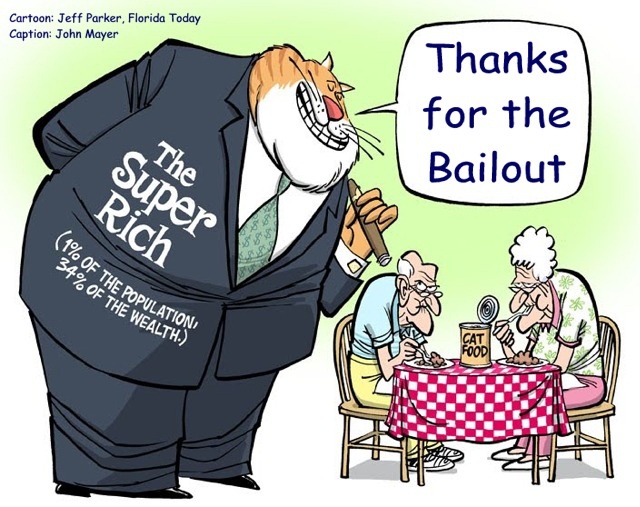
Fourth, again over my objection, Congress voted for a massive bailout of Wall Street. I didn't hear too many people talking about how we would pay for that $700 billion to bail out Wall Street. I didn't hear them worrying that it would drive up the deficit. Wall Street, having destroyed the economy through their reckless and illegal behavior, needed a welfare check and Congress provided it. End of story.
Those are some of the reasons we now have a deficit crisis, reasons Republicans don't talk much about when they provide soaring rhetoric about the dangers of large deficits.
The corporate media have been very lax in describing the devastating and unprecedented pain that the Republican House passed budget bill, HR 1, would bring about for low and moderate income families. Let me briefly mention just a very few of their cuts.
The Republicans want to decimate the Head Start Program. Every working family in America knows how hard it is today to find affordable childcare or early childhood education. At a time when we have the highest rate of childhood poverty in the industrialized world, the Republican solution is to slash Head Start by 20 percent, throw 218,000 children off the program and lay off 55,000 Head Start instructors.
The cost of college education today is so high that many young people are giving up their dream of going to college, while many others are graduating deeply in debt. The Republican solution? Make a bad situation much worse by slashing Pell grants by $5.7 billion and reducing or eliminating Pell grants for 9.4 million low-income college students.
Social Security is another target. We get calls in my office every week from senior citizens, people with disabilities, widows who are having a hard time getting a timely response to their Social Security claims. It takes much too long to process the paperwork today. What is the Republican solution? They want to slash the Social Security Administration, the people who administer Social Security, by $1.7 billion. That means half a million Americans who are legally entitled to Social Security benefits will have to wait significantly longer to receive them. (Become a citizen member of the Defending Social Security Caucus)
When it comes to health care, we have 50 million Americans with no insurance today, and 45,000 Americans die each year because they don't get to a doctor in time. Last year, as part of health care reform, I worked very hard to expand community health centers so that more and more low-and moderate-income people could walk into a doctor's office, get health care, dental care, low-cost prescription drugs, mental health counseling. What is the Republican response to the health care crisis? They want to drastically cut-back funding for community health centers and deny primary health care to 11 million Americans.
For the poorest of the poor in our country, the Community Services Block Grants provide the infrastructure, the mechanism to get out emergency help for food, heat, housing and other very basic necessities of life. With homelessness and poverty increasing, the Republicans want to slash $405 million from the Community Services Block Grant Program.
In cold weather states like Vermont, where the weather can get to 20 below zero, home heating assistance is critically important. In fact it is a life and death issue. At a time when home heating oil costs are soaring, the Republicans want to cut $400 million from the Low-Income Home Energy Assistance Program.
After decades of progress cleaning up our air and water, and preventing much illness, the Republicans want to slash the EPA by 30 percent and undercut enforcement of the Clean Air Act and the Clean Water Act.
Republicans also want to cut the WIC program, which provides supplemental nutrition for women, infants, and children. They want to cut that by $750 million.
Everybody understands we have problems with education right now, including large dropout rates. At a time when states are laying off hundreds of thousands of teachers, Republicans want to cut $5 billion from the Department of Education.
On and on and on it goes.
In my view, we do need to boldly address our deficit crisis, but we need to do it in a way that is fair -- that is not on the backs of the sick, the elderly, the children and the poor. In other words, we need shared sacrifice. The wealthiest people in this country, who are now doing phenomenally well, are also going to have to help us with deficit reduction. That is why I introduced legislation which would place a 5.4 percent emergency surtax on income over $1 million. The revenue would go into an Emergency Deficit Reduction Fund. Just doing that - asking millionaires to pay a little bit more in taxes after all the huge tax breaks they have received -- will bring in up to $50 billion a year.
I think that is a good idea, but it is not just me. An NBC News/Wall Street Journal poll recently asked the American people about the best ways to go forward on deficit reduction? Eighty-one percent of the American people believe it is totally acceptable or mostly acceptable to impose a surtax on millionaires to reduce the deficit. My legislation also would eliminate tax loopholes that enable the big oil companies from avoiding their fair share of taxes.
The American people get it. They understand that we cannot move toward deficit reduction just by cutting programs that working families, the middle class, and low-income people desperately need. They understand that serious, responsible deficit reduction requires shared sacrifice. They know that at a time when the top 1 percent earn more income than the bottom 50 percent, that when the effective tax rate for the rich is now lower than at any time in recent history, that it is absurd not to ask the wealthiest people in this country to provide additional revenue to help us lower the deficit.
The federal budget is not just a bunch of big numbers. It is the document that speaks to the values of our country, our national priorities and our hopes for the future. At a time when the gap between the very rich and everyone else is growing wider, it is a moral abomination to give more tax breaks to millionaires and billionaires, while cutting programs for the most vulnerable people in our society -- the children, the elderly, the sick and the hungry. The Republican budget proposal must be defeated.
Showing posts with label Middle Class. Show all posts
Showing posts with label Middle Class. Show all posts
Monday, March 14, 2011


Saturday, February 19, 2011
Do We Think We Are Better Off Than Our Parents? Only if your parents were named Wall and Street.

NEW YORK (CNN Money) -- Are you better off than your parents?
Probably not if you're in the middle class.
Incomes for 90% of Americans have been stuck in neutral, and it's not just because of the Great Recession. Middle-class incomes have been stagnant for at least a generation, while the wealthiest tier has surged ahead at lighting speed.In 1988, the income of an average American taxpayer was $33,400, adjusted for inflation. Fast forward 20 years, and not much had changed: The average income was still just $33,000 in 2008, according to IRS data.
Meanwhile, the richest 1% of Americans -- those making $380,000 or more -- have seen their incomes grow 33% over the last 20 years, leaving average Americans in the dust.
Experts point to some of the usual suspects -- like technology and globalization -- to explain the widening gap between the haves and have-nots.
But there's more to the story.
A real drag on the middle class
One major pull on the working man was the decline of unions and other labor protections, said Bill Rodgers, a former chief economist for the Labor Department, now a professor at Rutgers University.Because of deals struck through collective bargaining, union workers have traditionally earned 15% to 20% more than their non-union counterparts, Rodgers said. But union membership has declined rapidly over the past 30 years. In 1983, union workers made up about 20% of the workforce. In 2010, they represented less than 12%. "The erosion of collective bargaining is a key factor to explain why low-wage workers and middle income workers have seen their wages not stay up with inflation," Rodgers said. Without collective bargaining pushing up wages, especially for blue-collar work -- average incomes have stagnated.
International competition is another factor. While globalization has lifted millions out of poverty in developing nations, it hasn't exactly been a win for middle class workers in the U.S. Factory workers have seen many of their jobs shipped to other countries where labor is cheaper, putting more downward pressure on American wages. "As we became more connected to China, that poses the question of whether our wages are being set in Beijing," Rodgers said.

Finding it harder to compete with cheaper manufacturing costs abroad, the U.S. has emerged as primarily a services-producing economy. That trend has created a cultural shift in the job skills American employers are looking for. Whereas 50 years earlier, there were plenty of blue collar opportunities for workers who had only high school diploma, now employers seek "soft skills" that are typically honed in college, Rodgers said.
A boon for the rich
While average folks were losing ground in the economy, the wealthiest were capitalizing on some of those same factors, and driving an even bigger wedge between themselves and the rest of America.For example, though globalization has been a drag on labor, it's been a major win for corporations who've used new global channels to reduce costs and boost profits. In addition, new markets around the world have created even greater demand for their products.
"With a global economy, people who have extraordinary skills... whether they be in financial services, technology, entertainment or media, have a bigger place to play and be rewarded from," said Alan Johnson, a Wall Street compensation consultant.
As a result, the disparity between the wages for college educated workers versus high school grads has widened significantly since the 1980s. In 1980, workers with a high school diploma earned about 71% of what college-educated workers made. In 2010, that number fell to 55%.
Another driver of the rich: The stock market.
The S and P 500 has gained more than 1,300% since 1970. While that's helped the American economy grow, the benefits have been disproportionately reaped by the wealthy. And public policy of the past few decades has only encouraged the trend. The 1980s was a period of anti-regulation, presided over by President Reagan, who loosened rules governing banks and thrifts. A major game changer came during the Clinton era, when barriers between commercial and investment banks, enacted during the post-Depression era, were removed.In 2000, President Bush also weakened the government's oversight of complex securities, allowing financial innovations to take off, creating unprecedented amounts of wealth both for the overall economy, and for those directly involved in the financial sector. Tax cuts enacted during the Bush administration and extended under Obama were also a major windfall for the nation's richest.
And as then-Federal Reserve chairman Alan Greenspan brought interest rates down to new lows during the decade, the housing market experienced explosive growth. "We were all drinking the Kool-aid, Greenspan was tending bar, Bernanke and the academic establishment were supplying the liquor," Deutsche Bank managing director Ajay Kapur wrote in a research report in 2009.

But the story didn't end well. Eventually, it all came crashing down, resulting in the worst economic slump since the Great Depression. With the unemployment rate still excessively high and the real estate market showing few signs of rebounding, the American middle class is still reeling from the effects of the Great Recession.
Meanwhile, as corporate profits come roaring back and the stock market charges ahead, the wealthiest people continue to eclipse their middle-class counterparts. "I think it's a terrible dilemma, because what we're obviously heading toward is some kind of class warfare," Johnson said.
Sunday, November 14, 2010
Why middle income jobs are not coming back

The new normal is most defined by the
decimation of the middle class.
By Maureen Callahan
New York Post
11/14/10
Anne, 45, has always considered herself middle-class: As a single mom earning $65,000 a year in ad sales, she was able to rent a one-bedroom apartment on the Upper East Side for $1,000 a month and send her daughter, now 12, to private school. “I was able to make it,” she says. “Even go on vacation sometimes.”
In the span of 15 months, she has come to define herself as poor — even if the government won’t, denying her multiple applications for welfare and food stamps because, she says, she once made “too much money.”
Upon losing her job in June 2009 — her company was going under — “I was plunged into immediate poverty,” she says. “It was a surprise attack.”
Anne has borrowed money from her sister and her retired parents — who are struggling themselves — to pay the rent; she applied for a Section 8 and was able to slash it in half, to $500 a month. She depleted her 401(k). She had no savings, was living paycheck-to-paycheck. But she still felt economically safe, given her location and her tax bracket and her white-collar job.
“Now, when I go to the grocery store, I have to decide what is absolutely essential for my child,” Anne says. “Sometimes, I’m eating whatever-in-a-can. A lot of the time, I’m literally walking around without a penny in my pocket.” She deliberates before taking her daughter on a day trip downtown, because a round-trip subway fare will cost $9. She negotiated a tuition break with her daughter’s school, and the ease of that leads her to believe she’s not the only parent who’s asked, which she does not find especially comforting.
She’s $16,000 in debt to credit card companies. One of her local grocers, who once let her buy food on a running tab, now has a bill collector after her. She has her résumé up online, but when headhunters call and ask her age, “suddenly they never call me back,” she says. “I’m depressed. None of my friends are able to find jobs. I am living day-to-day.”
Anne’s biggest fear is that her daughter finds out how dire the situation is.
“She’ll say to me, ‘Are we poor?’ And I keep lying,” Anne says. “I think it’s a very traumatic thing for a child. I don’t want her to feel like she’s the only one, or a victim.”
When the recession does ease up, Anne fears that she will emerge as a permanent member of the lower class.
The decline of the middle class in America has been debated and discussed for 30 years — it was in the 1970s that middle-class wages began stagnating and education levels began declining — but it’s the Great Recession that has accelerated and intensified this decades-long trend. There is wealth and there is poverty, and the middle class — a category so vague that the majority of Americans, if asked, define themselves as such, whether they make $30,000 or $200,000 a year — are, in greater and greater numbers, downwardly mobile.
The median income is the US is now $50,000 a year, 5% less than it was in 2000. But whether one is middle class on that salary depends on a host of factors — your education level, how many dependents you have, where you live, whether you’re still paying off college loans, whether your mortgage is underwater.
“People with a college degree are the new working class,” says Lawrence Mishel, president of the Economic Policy Institute. He points to the long-term, exponentially increasing gap between rich and poor in America: from 1989-2007, the upper 1% of the population gained 56% of all income growth, while the bottom 90% gained just 16%.
“People have been doing poorly for a long time, but it’s not because they haven’t been working,” Mishel says. “It’s because the economy is working the way it’s designed to work.”
Middle income jobs not coming back
Subscribe to:
Posts (Atom)