
"Our Children and Grandchildren are not merely statistics towards which we can be indifferent" JFK
Showing posts with label Alan Greenspan. Show all posts

Saturday, February 19, 2011

Do We Think We Are Better Off Than Our Parents? Only if your parents were named Wall and Street.


By Annalyn Censky
Staff reporter


NEW YORK (CNN Money) -- Are you better off than your parents?

Probably not if you're in the middle class.
Incomes for 90% of Americans have been stuck in neutral, and it's not just because of the Great Recession. Middle-class incomes have been stagnant for at least a generation, while the wealthiest tier has surged ahead at lighting speed.

In 1988, the income of an average American taxpayer was $33,400, adjusted for inflation. Fast forward 20 years, and not much had changed: The average income was still just $33,000 in 2008, according to IRS data.

Meanwhile, the richest 1% of Americans -- those making $380,000 or more -- have seen their incomes grow 33% over the last 20 years, leaving average Americans in the dust.
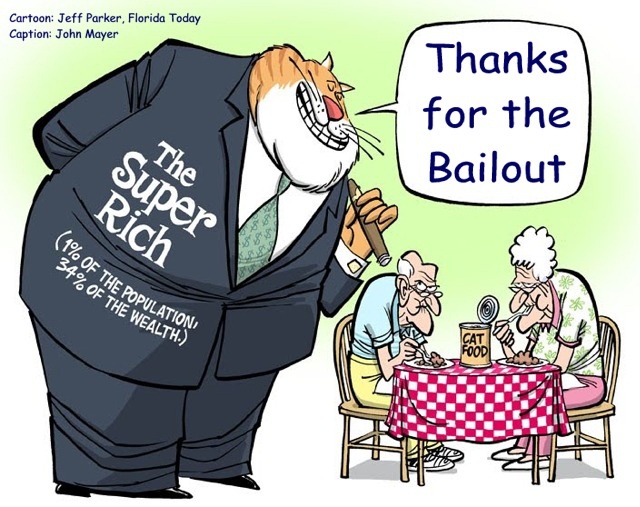

Experts point to some of the usual suspects -- like technology and globalization -- to explain the widening gap between the haves and have-nots.

But there's more to the story.

A real drag on the middle class
One major pull on the working man was the decline of unions and other labor protections, said Bill Rodgers, a former chief economist for the Labor Department, now a professor at Rutgers University.

Because of deals struck through collective bargaining, union workers have traditionally earned 15% to 20% more than their non-union counterparts, Rodgers said. But union membership has declined rapidly over the past 30 years. In 1983, union workers made up about 20% of the workforce. In 2010, they represented less than 12%. "The erosion of collective bargaining is a key factor to explain why low-wage workers and middle income workers have seen their wages not stay up with inflation," Rodgers said. Without collective bargaining pushing up wages, especially for blue-collar work -- average incomes have stagnated.

International competition is another factor. While globalization has lifted millions out of poverty in developing nations, it hasn't exactly been a win for middle class workers in the U.S. Factory workers have seen many of their jobs shipped to other countries where labor is cheaper, putting more downward pressure on American wages. "As we became more connected to China, that poses the question of whether our wages are being set in Beijing," Rodgers said.


Finding it harder to compete with cheaper manufacturing costs abroad, the U.S. has emerged as primarily a services-producing economy. That trend has created a cultural shift in the job skills American employers are looking for. Whereas 50 years earlier, there were plenty of blue collar opportunities for workers who had only high school diploma, now employers seek "soft skills" that are typically honed in college, Rodgers said.

A boon for the rich
While average folks were losing ground in the economy, the wealthiest were capitalizing on some of those same factors, and driving an even bigger wedge between themselves and the rest of America.

For example, though globalization has been a drag on labor, it's been a major win for corporations who've used new global channels to reduce costs and boost profits. In addition, new markets around the world have created even greater demand for their products.

"With a global economy, people who have extraordinary skills... whether they be in financial services, technology, entertainment or media, have a bigger place to play and be rewarded from," said Alan Johnson, a Wall Street compensation consultant.

As a result, the disparity between the wages for college educated workers versus high school grads has widened significantly since the 1980s. In 1980, workers with a high school diploma earned about 71% of what college-educated workers made. In 2010, that number fell to 55%.

Another driver of the rich: The stock market.
The S and P 500 has gained more than 1,300% since 1970. While that's helped the American economy grow, the benefits have been disproportionately reaped by the wealthy. And public policy of the past few decades has only encouraged the trend. The 1980s was a period of anti-regulation, presided over by President Reagan, who loosened rules governing banks and thrifts. A major game changer came during the Clinton era, when barriers between commercial and investment banks, enacted during the post-Depression era, were removed.

In 2000, President Bush also weakened the government's oversight of complex securities, allowing financial innovations to take off, creating unprecedented amounts of wealth both for the overall economy, and for those directly involved in the financial sector. Tax cuts enacted during the Bush administration and extended under Obama were also a major windfall for the nation's richest.

And as then-Federal Reserve chairman Alan Greenspan brought interest rates down to new lows during the decade, the housing market experienced explosive growth. "We were all drinking the Kool-aid, Greenspan was tending bar, Bernanke and the academic establishment were supplying the liquor," Deutsche Bank managing director Ajay Kapur wrote in a research report in 2009.

But the story didn't end well. Eventually, it all came crashing down, resulting in the worst economic slump since the Great Depression.  With the unemployment rate still excessively high and the real estate market showing few signs of rebounding, the American middle class is still reeling from the effects of the Great Recession.

Meanwhile, as corporate profits come roaring back and the stock market charges ahead, the wealthiest people continue to eclipse their middle-class counterparts. "I think it's a terrible dilemma, because what we're obviously heading toward is some kind of class warfare," Johnson said.


Wednesday, October 27, 2010

Night of the Living Fed by Jeremy Grantham, Bernanke Expresses No Concern about Bubbles

I would force the Federal Reserve to swear off
manipulating asset prices 

Night of the Living Fed Report

If I were a benevolent dictator, I would strip the Fed of its obligation to worry about the economy and ask it to limit its meddling to attempting to manage infl ation. Better yet, I would limit its activities to making sure that the economy had a suitable amount of liquidity to function normally. Further, I would force it to swear off manipulating asset prices through artificially low rates and asymmetric promises of help in tough times – the Greenspan/Bernanke put.

To Summarize
It would be a better, simpler, and less dangerous world, although one much less exciting for us students of bubbles. Only by hammering away at its giant past mistakes as well as its dangerous current policy can we hope to generate enough awareness by 2014: Bernanke’s next scheduled reappointment hearing.

It seems certain that the Fed is aware that low rates and moral hazard encourage higher asset prices and increased speculation, and that higher asset prices have a beneficial short-term impact on the economy, mainly through the wealth effect. It is also probable that the Fed knows that the other direct effects of monetary policy on the economy are negligible.

The Fed, both now and under Greenspan, expressed no concern with the later stages of investment bubbles. This sets up a much-increased probability of bubbles forming and breaking, always dangerous events. Even as much of the rest of the world expresses concern with asset bubbles, Bernanke expresses none. (Yellen to the rescue?)

Lower rates always transfer wealth from retirees (debt owners) to corporations (debt for expansion, theoretically) and the financial industry. This time, there are more retirees and the pain is greater, and corporations are notably avoiding capital spending and, therefore, the benefits are reduced. It is likely that there is no net benefit to artificially low rates.

Sunday, August 1, 2010

Sunday Comics

Ahhhhh Ben, what exactly did you mean...
outlook for the U.S. economy is "unusually uncertain"?
went on record stating,
"You're seeing private investment expand again,
job growth starting to come back.
And that's very encouraging"


SEC's New Protocol for assessing fines
on companies accused of fraud and
or accounting improprieties.
No changes to "no ask no tell" policy
on admission of wrongdoing.
...and no one every does jail time...


Hey Charlie Rangel, Maxine Waters wants to read
it before returning to the library


Standard SEC issue since passage of
Financial Reform. SEC is now "selectively" exempt
from Freedom of Information Act.


Likely number of politicians who read the
financial reform bill prior to voting.


BP's legal strategy...offer a one time payment and
you promise not to sue us...trust us to do the right thing


Alan Greenpan: economy is having a modest recovery,
but right now there's a "pause" in that recovery,
 so it feels like a "quasi-recession."


Alan Greenspan: a rising stock market will do more to
stimulate the economy than any of the remedies
now being discussed.


Tuesday, July 20, 2010

Ben Bernanke to testify before the Senate Banking Committee (sitting in their underwear)

Fed Chairman Ben S. Bernanke will give his semiannual report on monetary policy to the Senate Banking Committee Wednesday and will testify at the House Financial Services Committee on July 22.
I don't know what else to do, all I have done is
University stuff...

Ben, I know you are testifying Wednesday and when
Ron Paul gets in your face, just dial it down
and take a deep breath.
It worked for me when Elizabeth Warren
was in my face about the
whole AIG/Goldman Sachs thing.

Just imagine the Senate Banking Committee
sitting there in their underwear...really,
it works...I did it for almost 20 years.

Ben, I know the finanical reform bill is basically
bunk however we expanded your authority and you
are now like a God, so I really
need you to sell it during your testimony as
we really need to public to invest in the market.


Just relax. You do this twice a year. Remember what
Greenspan told you about them sitting there in
their underwear? How do you think I almost got away
with a $750 Billion 3 page TARP plan!

Monday, May 3, 2010

Greenspan wanted housing-bubble dissent kept secret (Huffington Post)

Ryan Grim-Huffington Post
As top Federal Reserve officials debated whether there was a housing bubble and what to do about it, then-Chairman Alan Greenspan argued that the dissent should be kept secret so that the Fed wouldn't lose control of the debate to people less well-informed than themselves.

"We run the risk, by laying out the pros and cons of a particular argument, of inducing people to join in on the debate, and in this regard it is possible to lose control of a process that only we fully understand," Greenspan said, according to the transcripts of a March 2004 meeting.

At the same meeting, a Federal Reserve bank president from Atlanta, Jack Guynn, warned that "a number of folks are expressing growing concern about potential overbuilding and worrisome speculation in the real estate markets, especially in Florida. Entire condo projects and upscale residential lots are being pre-sold before any construction, with buyers freely admitting that they have no intention of occupying the units or building on the land but rather are counting on 'flipping' the properties--selling them quickly at higher prices."

Had Guynn's warning been heeded and the housing market cooled, the financial collapse of 2008 could have been avoided. But his comment was kept secret until Friday, when the central bank released the transcripts of Federal Open Market Committee meetings for 2004 and CalculatedRisk spotted it. The transcripts for 2005 to the present are still secret.

"The substantial run-up in house prices, which we have followed in Florida and also see in the populous Northeast and West Coast of the United States, may be at least partially attributable to unusually low mortgage rates influenced by our very accommodative policy," Guynn warned.

But when the Fed released contemporaneous minutes of the meeting, the bank downplayed Guynn's concerns.

"Reports from some contacts suggested that speculative forces might be boosting housing demand in some parts of the country, with concomitant effects on prices, suggesting the possibility that house prices might be moving into the high end of the range that could be consistent with fundamentals," reads the minutes, which were released to the public several weeks after the meeting.

Link to complete article


Care to ponder on the words of wisdom Greenspan
is sharing with Helicopter Ben? "Birds of a feather..."


Tuesday, April 13, 2010

The Most Ridiculous Excuse Ever: "No One Saw The Crisis Coming" (Tech Ticker)

Tech/Ticker
So for folks like Bob Rubin (former Treasury Secretary and Citi advisor) and Alan Greenspan (former Fed Chair) to suggest that the financial crisis was impossible to foresee is disingenuous. The particulars of the crisis--the when, what, and how--might have been impossible to foresee. But the idea that, someday, there might be a day of reckoning, and that this day of reckoning might catch people by surprise, is as basic as economic and market forecasting gets.

Ken Posner, a former financial-services analyst at Morgan Stanley and author of Stalking The Black Swan, says that what people need to do is prepare themselves for such crises and behave as though they might occur anytime. He also says that, when the crises do occur, people in power need to learn to see them faster--and react accordingly.

Robert "Ransack" Rubin pulled in a cool $126 million in cash and stock during his 8 year stint with Citigroup. The fleecing of America continues and in the words of Steve Urkel, "Did I do that"?

Wednesday, April 7, 2010

Alan Greenspan...Bubbleman remains clueless and not my fault

Reuters News:
Former Federal Reserve Chairman Alan Greenspan denied that the U.S. central bank helped inflate housing prices and isn't to blame for the subprime fiasco. 

Grandpa: of course you are not to blame Alan. For the record oh great one:
1. 2005 grandma and grandpa were in real estate
2. we sold and bought a house the same year
3. held a grandma/grandpa meeting to discuss the real estate marketplace
4. reason for meeting: knew the market could not continue its illogical rise
    as people brought along a friend to fog the mirror so they could
    secure a mortgage
5. grandpa calculated that many "boutique" real estate brokers would
    fold and grandma would be better served with a larger and more
    financially sound broker
6. grandma moved to a different broker, real estate market crashed and prior
    "boutique real estate broker" is no longer with us...
7. you see Alan, we are just those simple folk, not part of the elite D.C.
    or Wall Street crowd. We pay our bills, assume responsibility for our
    decisions. We simple folk do not compromise our values based on the
    need for re-appointment or re-election.

Hey Alan, offer my simply, left brain, realist and "pragmatic perspective" consulting services to Helicopter Ben as he is singing the same tune! I will not hold my breath as I am quite sure you do not see the Bernanke bubble filling.....