"Our Children and Grandchildren are not merely statistics towards which we can be indifferent" JFK
Showing posts with label Wall Street. Show all posts

Saturday, October 8, 2011

Herman Cain has it all figured out; the loser unemployed are to blame

“Don’t blame Wall Street,” Cain told The Wall Street Journal this week. ”Don’t blame the big banks, if you don’t have a job and you’re not rich, blame yourself!”

"I don't have facts to back this up, but I happen to believe that these demonstrations are planned and orchestrated to distract from the failed policies of the Obama administration."


Pillsbury appointed Cain as President and CEO of Godfather's Pizza. Aiming to cut costs, Cain, over a 14-month period, reduced the company from 911 stores to 420. As a result of his efforts, Godfather's Pizza became profitable. In a leveraged buyout in 1988, Cain, Executive Vice-President and COO Ronald B. Gartlan and a group of investors, bought Godfather's from Pillsbury. Cain continued as CEO until 1996, when he resigned.

"Don't blame Wall Street or the Big Banks for losing your Godfather's Pizza job, blame yourself."


"It is not someone’s fault if they succeeded, it is someone’s fault if they failed." Look at me I cut costs and fire people, I succeeded.

Tuesday, July 5, 2011

7 Reasons Why America Needs a Good Depression NOW (Paul Farrell)

On Behalf of Grandchildren Everywhere...
Thank You Mr. Farrell

MarketWatch
By: Paul B. Farrell
July 5, 2011

SAN LUIS OBISPO, Calif. (MarketWatch) — No, do not raise the debt-ceiling. You heard me: Block the debt ceiling vote. Don’t raise it. America’s out-of-control. A debt addict. Time to detox. Deal with the collateral damage before it’s too late.

We need to fix America’s looming credit default, failing economy and our screwed-up banking system. Now, with a Good Depression. If we just kick the can down the road one more time, we’ll be trapped into repeating our 1930’s tragedy, a second Great Depression.

Yes, depression. Spelled: d-e-p-r-e-s-s-i-o-n. Wake up America, recessions do not work. Won’t work in the future. Remember that 30-month recession after the dot-com crash? Didn’t work. Why? Because in the decade since that 2000 peak, Wall Street’s lost an inflation–adjusted 20% of America’s retirement money.

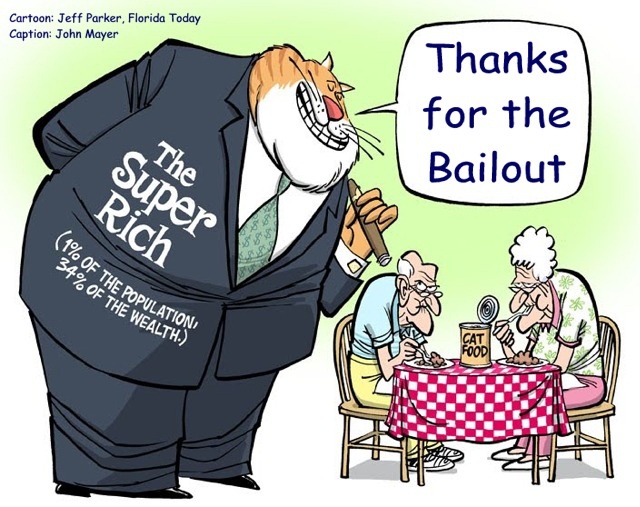
And what about the so-called Great Recession of the 2008 credit meltdown? Didn’t work either. In fact, made matters worse: Wall Street got richer by stealing from the other 98% of Americans, the middle class, the poor. And now their conservative puppets in Washington want to make matters worse, widening the wealth gap further to benefit the Super Rich.

Seems nobody really gives a damn about our great nation any more. America’s now a capitalists anarchy: “Every (rich) man for himself.” Proxy battles are fought by high-priced lobbyists in a broken political system. America needs a 21-gun wake-up call. Yes, that’s why America needs a Good Depression. The economy’s bad now. But kicking the can down the road again will make matters much worse later.

America’s leaders lost their moral compass, lack a public conscience
 
This is not our first call for a Good Depression. As early as 2005 we began reporting on excessive debt. In November 2007 we warned of a crash dead ahead. The subprime credit meltdown had been accelerating for many months, although for a year our leaders kept misleading Americans: Fed Chairman Ben Bernanke’s “it’s under control.” Treasury Secretary Henry Paulson’s delusional “best economy I’ve ever seen in my lifetime.”
 
In August 2008 came the original of our seven reasons why America needs a Good Depression. Yes August, just two months before Wall Street banks collapsed into de facto bankruptcy, after many warnings predicting a crisis. This was no Black Swan. In September 2008 we reported on Naomi Klein, author of “Shock Doctrine: The Rise of Disaster Capitalism,” warning of Wall Street’s insidious plan to take over America:
 
“Nobody should believe the overblown claims that the market crisis signals the death of ‘free market’ ideology.” Then as the meltdown went nuclear, Klein warned: “Free market ideology has always been a servant to the interests of capital, and its presence ebbs and flows depending on its usefulness to those interests. During boom times, it’s profitable to preach laissez faire, because an absentee government allows speculative bubbles to inflate.”
 
But “when those bubbles burst, the ideology becomes a hindrance, and it goes dormant while big government rides to the rescue. But rest assured,” she predicted, Reaganomics “ideology will come roaring back when the bailouts are done. The massive debts the public is accumulating to bail out the speculators will then become part of a global budget crisis that will be the rationalization for deep cuts to social programs, and for a renewed push to privatize.”
 
Totally predictable: No Black Swans in 2000, 2008 … nor in 2012
 
Yes, all was predictable: The events of the past few years were well known in advance. In fact, the events of the entire decade were predictable. The rich got richer off the backs of the middle class and the poor. Why? “There’s class warfare all right,” warns Warren Buffett. “But it’s my class, the rich class, that’s making war, and we’re winning.”
 
And they are also blind and deaf to the havoc their free-market Reaganomics policies are creating, selfishly undermining America, the world’s greatest economic power.
 
Lessons learned? Zero. Why? Wall Street, Washington and Corporate America are focused on one narrow-minded short-term strategy: Economic g-r-o-w-t-h, bull markets, megabonuses, tax cuts. In good times they tout “free markets.” But when greed bombs, they throw free-market “principles” under the Reagan Revolution bus and unleash their mercenary lobbyists to go whining to Congress for huge taxpayer bailouts and access at the Fed discount window, to siphon off more taxpayer money. And they’ll do it again soon.
 
Wall Street and their cronies are doing such a miserable job, America needs a new strategy: First, stop “kicking the can down the road.” Let a good old-fashioned Good Depression do the job that our hapless, happy-talking leaders refuse to do. Take our medicine. Let a new depression clean house and reawaken Americans to core values.
 
Trust me folks, it’s either a Good Depression now … or a Great Depression 2. Here are seven reasons favoring the do-it-now strategy:
 
1: Capitalism’s now a lethal soul sickness, needs a reawakening
What’s the real problem? Not the economy, not markets, nor even politics. Yes, our economic pains are real. But they’re just symptoms. Something’s structural wrong. Since 2000 endless bad news: Greed, deceit, stupidity, corruption, unethical behavior, lack of moral conscience.
 
The real problem’s deep in our character, the “mutant capitalism” Jack Bogle warned of in “The Battle for the Soul of Capitalism.” Sadly, that battle was lost. With it we lost our soul, our moral compass. America’s character is measured by our net worth.
 
2. We’re already in the early stages of a Great Depression
Comparing today with the Great Depression is common sport. In a Newsweek special “Seeing Shades of the 1930s,” Dan Gross wrote: “Wall Street, after two terms of a business-friendly Republican president, self-immolated on a pyre of greed, incompetence and excessive optimism.” Today’s “new normal” economy means high unemployment for years, inflation driving prices, rising interest rates, more debt, chaos.
 
We are destroying ourselves from within. Former U.S. Comptroller General David Walker warns that “there are striking similarities between America’s current situation and that of another great power from the past: Rome.” Three reasons “worth remembering: declining moral values and political civility at home, an overconfident and overextended military in foreign lands, and fiscal irresponsibility by the central government.” We are becoming more vulnerable to external enemies.
 
3. Good Depression exposes our self-destruct bubble-thinking
Before the 2008 crash, “Irrational Exuberance” author Robert Shiller warned in the Atlantic magazine that “bubbles are primarily social phenomena. Until we understand and address the psychology that fuels them, they’re going to keep forming.” Housing inflated 85% in the decade: “Historically unprecedented … no rational basis for it.”
 
Bubble thinking is an toxic virus that infected everyone. Shiller warns of another coming: “We recently lived through two epidemics of excessive financial optimism … we are close to a third episode.”

Keep Reading

Monday, February 21, 2011

Dylan Ratigan: Where are the handcuffs? Fraud in the financial system. Oh, by the way, Angelo Mozilo WALKS!!

February 17, 2011 on the Dylan Ratigan Show: Where are the handcuffs? Thousands jailed during the S and L crisis. Why not know? Charles Ferguson, director of the "Inside Job" share with Dylan Ratigan that everyone within the Obama Administration refused an interview request for the "Inside Job" documentary.


If this interview didn't get you blood boiling, how about news the very next day!

Mozilo's actions in the mortgage meltdown
which led to $67.5-million settlement against him
did not amount to criminal wrongdoing,
federal prosecutors have determined


Los Angeles Times
February 18, 2011
By E. Scott Reckard


As the former chairman of Countrywide Financial Corp., Mozilo helped fuel the boom in risky subprime loans that led to the crippling of the banking industry and the near-collapse of the financial system.

A federal grand jury in Los Angeles began probing Mozilo in 2008, and four months ago he agreed to pay a $22.5-million fine and to repay $45 million in what the government said were ill-gotten gains to former Countrywide shareholders. The payments settled a civil action by the Securities and Exchange Commission.

But the criminal investigation has wound down without indictments of Mozilo or others at his Calabasas company, according to people familiar with both the prosecution and the defense teams, all of whom spoke on condition of anonymity because they were not authorized to discuss the matter.

"Sometimes the public thinks all you have to do is to indict someone and that's it," one of the federal sources said. "But you have to be able to prove your case, and it can be worse losing a case than not bringing one at all."

The 72-year-old Mozilo hung up the phone when contacted for comment at his home in the Lake Sherwood golf community of Ventura County.

The criminal investigation into Mozilo was never announced publicly, and as a rule federal prosecutors make no formal announcement when such cases are closed.

One defense attorney, however, said the government would probably keep a close watch on civil litigation by Countrywide shareholders against Mozilo and could still decide to bring charges depending on what develops in those cases.

"He may have to testify, and you never know what may come up," the attorney said.

Asst. U.S. Atty. Stephen A. Cazares, who spearheaded the Countrywide criminal probe, could not be reached for comment. A spokesman for U.S. Atty. Andre Birotte Jr. said the office would have no comment "at this time." If you dare to care, keep reading


Federal prosecutors have shelved a criminal investigation of Angelo R. Mozilo after determining that his actions in the mortgage meltdown — which led to $67.5-million settlement against him — did not amount to criminal wrongdoing.

Saturday, February 19, 2011

Do We Think We Are Better Off Than Our Parents? Only if your parents were named Wall and Street.


By Annalyn Censky
Staff reporter


NEW YORK (CNN Money) -- Are you better off than your parents?

Probably not if you're in the middle class.
Incomes for 90% of Americans have been stuck in neutral, and it's not just because of the Great Recession. Middle-class incomes have been stagnant for at least a generation, while the wealthiest tier has surged ahead at lighting speed.

In 1988, the income of an average American taxpayer was $33,400, adjusted for inflation. Fast forward 20 years, and not much had changed: The average income was still just $33,000 in 2008, according to IRS data.

Meanwhile, the richest 1% of Americans -- those making $380,000 or more -- have seen their incomes grow 33% over the last 20 years, leaving average Americans in the dust.


Experts point to some of the usual suspects -- like technology and globalization -- to explain the widening gap between the haves and have-nots.

But there's more to the story.

A real drag on the middle class
One major pull on the working man was the decline of unions and other labor protections, said Bill Rodgers, a former chief economist for the Labor Department, now a professor at Rutgers University.

Because of deals struck through collective bargaining, union workers have traditionally earned 15% to 20% more than their non-union counterparts, Rodgers said. But union membership has declined rapidly over the past 30 years. In 1983, union workers made up about 20% of the workforce. In 2010, they represented less than 12%. "The erosion of collective bargaining is a key factor to explain why low-wage workers and middle income workers have seen their wages not stay up with inflation," Rodgers said. Without collective bargaining pushing up wages, especially for blue-collar work -- average incomes have stagnated.

International competition is another factor. While globalization has lifted millions out of poverty in developing nations, it hasn't exactly been a win for middle class workers in the U.S. Factory workers have seen many of their jobs shipped to other countries where labor is cheaper, putting more downward pressure on American wages. "As we became more connected to China, that poses the question of whether our wages are being set in Beijing," Rodgers said.


Finding it harder to compete with cheaper manufacturing costs abroad, the U.S. has emerged as primarily a services-producing economy. That trend has created a cultural shift in the job skills American employers are looking for. Whereas 50 years earlier, there were plenty of blue collar opportunities for workers who had only high school diploma, now employers seek "soft skills" that are typically honed in college, Rodgers said.

A boon for the rich
While average folks were losing ground in the economy, the wealthiest were capitalizing on some of those same factors, and driving an even bigger wedge between themselves and the rest of America.

For example, though globalization has been a drag on labor, it's been a major win for corporations who've used new global channels to reduce costs and boost profits. In addition, new markets around the world have created even greater demand for their products.

"With a global economy, people who have extraordinary skills... whether they be in financial services, technology, entertainment or media, have a bigger place to play and be rewarded from," said Alan Johnson, a Wall Street compensation consultant.

As a result, the disparity between the wages for college educated workers versus high school grads has widened significantly since the 1980s. In 1980, workers with a high school diploma earned about 71% of what college-educated workers made. In 2010, that number fell to 55%.

Another driver of the rich: The stock market.
The S and P 500 has gained more than 1,300% since 1970. While that's helped the American economy grow, the benefits have been disproportionately reaped by the wealthy. And public policy of the past few decades has only encouraged the trend. The 1980s was a period of anti-regulation, presided over by President Reagan, who loosened rules governing banks and thrifts. A major game changer came during the Clinton era, when barriers between commercial and investment banks, enacted during the post-Depression era, were removed.

In 2000, President Bush also weakened the government's oversight of complex securities, allowing financial innovations to take off, creating unprecedented amounts of wealth both for the overall economy, and for those directly involved in the financial sector. Tax cuts enacted during the Bush administration and extended under Obama were also a major windfall for the nation's richest.

And as then-Federal Reserve chairman Alan Greenspan brought interest rates down to new lows during the decade, the housing market experienced explosive growth. "We were all drinking the Kool-aid, Greenspan was tending bar, Bernanke and the academic establishment were supplying the liquor," Deutsche Bank managing director Ajay Kapur wrote in a research report in 2009.

But the story didn't end well. Eventually, it all came crashing down, resulting in the worst economic slump since the Great Depression.  With the unemployment rate still excessively high and the real estate market showing few signs of rebounding, the American middle class is still reeling from the effects of the Great Recession.

Meanwhile, as corporate profits come roaring back and the stock market charges ahead, the wealthiest people continue to eclipse their middle-class counterparts. "I think it's a terrible dilemma, because what we're obviously heading toward is some kind of class warfare," Johnson said.


Sunday, February 13, 2011

The stock market is overbought and is losing momentum (this is not a test)

In summary, the current excitement about
the market reminds us of the
extreme bullishness exhibited near the
tops in early 2000 and late 2007.
The outcome is likely to be the same.

Comstock Partners
February 3, 2011
The stock market is at a highly vulnerable point, both fundamentally and technically. Fundamentally, the current rate of economic growth is unsustainable and the valuation of the S and P 500 is significantly above its long-term average. Technically, the market is overbought and is losing momentum. We cite the following points.
  • Consumer spending has been outpacing the ability to spend. Spending has exceeded income in five of the last six months. During this time nominal spending has increased 2.8%, compared to only 1.9% in personal income. In order to accomplish this, households took their savings rate down to 5.3% of income from 6.3% six months earlier. As we have pointed out numerous times, household debt is still near record levels and consumers still have a long way to go in deleveraging their balance sheets.
  • Housing remains a major weak spot with a rising pipeline of coming foreclosures, excess inventories and falling prices. In addition rising bond rates are causing mortgage rates to climb. (UPDATE: 30 year mortgage rate jumped to 5.05% this past week from 4.81% prior week)
  • States and local governments are slashing budgets through a combination of raising taxes and cutting spending. This, obviously, is a major drag on the overall economy.
  • Private jobs have increased at an average of 112,000 a month over the past year, but about half of that has been in low-paying health care, social services and temporary employment. (UPDATE: on 2/4/11, BLS reported a net +36,000 jobs in January)
  • QE2 is scheduled to end in five months. Just as the anticipation of QE2 in August led to a substantial rise in the market, the anticipation of its ending may well have the opposite effect, combined with the other factors we mention.
  • With commodity prices soaring and consumers unable or unwilling to accept price increases, a large number of corporations will undergo major cost increases that will squeeze profit margins, a factor not calculated into current earnings forecasts. (UPDATE: Kraft Foods states revenue growth will be from higher prices versus higher volume)
  • Europe's sovereign debt problems have not been solved and the crisis will continue to fester. Any real solution will not be friendly to economic growth.
  • The crisis in Tunisia and Egypt are not random exogenous events. Soaring food prices, high unemployment and wealth disparities are as much a factor as repressive governments. People tend to tolerate dictatorships more when they aren't hungry.
  • China is a bubble waiting to burst. Think back to the late 80's when everyone was as optimistic about Japan as they are about China today.
  • At today's closing price the S and P 500 is selling at 19.2 times cyclically smoothed reported earnings, compared to a historical average of about 15. (UPDATE: the S and P 500 is up another 34 points/2.7% as of the close on 2/11/11)
  • In addition to the above fundamentals the market is technically vulnerable. It has climbed about 95% over the last 23 months and 30% since the July low. Sentiment has become heavily bullish while the market is losing momentum as fewer stocks are moving higher on each successive top. Volume for advancing stocks is dropping while volume for declining stocks is rising. The number of new daily highs is also dropping as is the percentage of stocks making new 50-day highs.
In sum, the current excitement about the market reminds us of the extreme bullishness exhibited near the tops in early 2000 and late 2007. The outcome is likely to be the same. Add'l Posts/Articles by Comstock Partners

Thursday, February 10, 2011

Dylan Ratigan is Fed Up, Dylan starts the bonfire and Bernie Sanders Provides a Cord of Wood

Dylan Ratigan and Senator Bernie Sanders are both Fed Up with the fact that not one person connected with mortgage fraud has been prosecuted. Bernie Sanders notes while 42,000 U.S. factories closed during a 10 year period, Wall Street Banks invented toxic financial products in lieu of investing in American businesses that actually make something.

Bernie adds more wood to Dylan's bonfire pointing out that the 4 largest financial institutions in America hold assets equal to 1/2 of the country's entire GDP. They also account for 1/2 of all mortgages and 2/3 of all credit cards. Bernie points what many of us have asked ourselves; does the government regulate Wall Street or is Wall Street regulating the government?

Grab a cold one as Dylan is not a happy camper!


Wednesday, February 2, 2011

Wall Street Compensation Sets Another Record at $135 billion (9+ miles of $1,000 bills)

Seneca Niagara Casino Hotel and Tower is 358' Tall
Stack of $1,000 bills to the Very Top of this Building equals $1 bil
Wall Street Compensation in 2010 is 135 of these buildings


The Wall Street Journal
By Aaron Lucchetti and
Stephen Grocer
2/2/2011

When it comes to paychecks, Wall Street's law of gravity is back in full force: What goes down must come back up.

In 2010, total compensation and benefits at publicly traded Wall Street banks and securities firms hit a record of $135 billion, according to an analysis by The Wall Street Journal. The total is up 5.7% from $128 billion in combined compensation and benefits by the same companies in 2009.

The increase was fueled by a revenue rebound as the financial crisis recedes in the rearview mirror. At 25 large financial firms that have reported full-year results, revenue rose to $417 billion, another all-time high, even though last year's 1% increase was just a fraction of the industry's revenue jolt from 2008 to 2009 as trading and investment banking sprang back to life.

"Things are shifting back to where they were before," said J. Robert Brown, a law professor at the University of Denver who studies compensation and corporate-governance issues.

Buried in the numbers, though, are signs of how Wall Street's pay culture is bending in response to pressure from regulators and shareholders. Last year, deferred compensation made up as much as half of total pay, up from about a third previously, estimates Alan Johnson, managing director of Johnson Associates Inc., a New York pay consultant.

Bank of America Chief Executive Brian Moynihan got a 67% bump in his total compensation for 2010, the company said Monday. Goldman Sachs Group Inc. tripled the salary of Chairman and CEO Lloyd C. Blankfein and increased his stock-based bonus 40% to $12.6 million. Rest of $135 Billion Record Compensation

Huffington Post Also Weighs In
Wall Street pay is rising, while income for normal Americans has stagnated.

Even as the real economy limped, financial firms paid employees a record sum last year, the Wall Street Journal reports. In 2009, the last full year data are available, average wages for Americans fell 1.5 percent from the previous year, according to the National Average Wage Index. Median household income in 2009 was "not statistically different" from 2008, according to the Census Bureau.

But total pay at Wall Street firms rose 5.7 percent in 2010, as the 25 companies that have already reported results shelled out a record $135 billion. Even as regulators pressured firms to alter compensation, prominent executives got big pay bumps, seeming to suggest that the former Wall Street culture has emerged virtually unscathed from the recession.

Grandpa would be Remiss Without Affording Tim Geithner
Recognition and Accolades for His Contributions
to those Hard Working Folks on Wall Street

Treasury Secretary Timothy Geithner tackles five Myths about TARP: 1) cost taxpayers hundreds of billions of dollars, 2) was a gift for Wall Street that did nothing for Main Street, 3) left our financial system in weakened condition, 4) increased concentration in the financial system, and 5) served as the centerpiece of the Obama Administration’s strategy to control the economy.


Tuesday, January 25, 2011

Merrill (Bank of America) Pays $10 mil to hop over the Chinese Wall

Remember the Chinese Wall, you know, the wall that separates Wall Street proprietary traders and those placing client orders. Like when you call your financial advisor to place a trade assuming it is between you and the advisor. Yeah right! Oh your order was filled, however you paid more than you had to because the information was shared with the proprietary traders so they could buy ahead of you, make a few pennies and sell you their shares at a higher cost.

Remember though, these are the fine folks that received a TARP bailout in order to prevent financial armageddon and it was good for we Main Street folk. When they get caught with their hand in the cokkie jar, just write out a check and admit to NOTHING!

By Jonathan Stempel
1/25/2011

(Reuters) - Bank of America Corp's Merrill Lynch unit agreed to pay $10 million to settle U.S. Securities and Exchange Commission charges that it fraudulently misused customer orders so it could trade for its own benefit.

The settlement stemmed from SEC charges that Merrill used the order information to place proprietary trades on a desk it no longer operates. The SEC also accused Merrill of charging hidden trading fees to institutional and wealthy customers.

Merrill did not admit wrongdoing in agreeing to settle.

"It's a slap on the wrist," said David Robbins, a partner at the law firm Kaufmann, Gildin, Robbins & Oppenheim LLP in New York and a former compliance chief at the American Stock Exchange. "This penalty is like a traffic ticket. If the desk had still been around, you can be sure the sanction would have been to close it down."

According to the SEC, from February 2003 to February 2005 Merrill operated a proprietary trading desk on its equity trading floor in New York known as the Equity Strategy Desk.

It said that while Merrill told customers their orders would generally be kept private, traders on the Equity Strategy Desk would learn information about orders from institutional clients and use it to place trades with Merrill's own money.

"Investors have the right to expect that their brokers won't misuse their order information," Scott Friestad, associate director in the SEC enforcement unit, said in a statement. "The conduct here was clearly inappropriate."

The SEC also found that from 2002 to 2007, Merrill charged undisclosed fees to some institutional and high-net-worth customers when filling orders for "riskless principal trades."

Such trades occur when a broker-dealer receives a customer order, conducts a contemporaneous offsetting trade, and then "allocates" the securities to the customer, the SEC said.

Bill Halldin, a Bank of America spokesman, said in a statement that Merrill has adopted "a number of policy changes" to separate proprietary trading from other trading, and has improved training and supervision related to principal trades.

The SEC said the $10 million penalty took into account remedies taken by Merrill after Charlotte, North Carolina-based Bank of America acquired the company at the beginning of 2009. Bank of America is the largest U.S. bank by assets.

"The fact Merrill didn't self-regulate is the bigger problem," Robbins said. "I hope other firms will see this as a signal to stop trading on confidential customer information."


Tuesday, January 11, 2011

Surest way to profit from takeover speculation in the stock market is to bet it’s wrong.

Deliberately spreading false rumors may
violate securities laws, especially if
the intent is to sway prices
(appears the SEC quietly endorses rumors if stock
price moves higher, however don't you dare
start a rumor that sends a stock lower...)


By Tara Lachapelle
Jan. 11 (Bloomberg) -- The surest way to profit from takeover speculation in the stock market is to bet it’s wrong.

Electronic news services, brokerages and newspapers reported at least 1,875 rumors about potential buyouts of 717 companies between 2005 and 2010, according to data compiled by Bloomberg. A total of 104, or 14.5 percent, were acquired, the data show. While stocks that were the subject of takeover speculation initially jumped 2.9 percent, betting on declines yielded average profits of 1.2 percent in the next month, an annualized gain of 14 percent.

Opportunities to employ the strategy are increasing as mergers recover from the worst recession in more than 70 years, data compiled by Bloomberg show. After bottoming in 2008, the number of unconfirmed stories about possible mergers surged 71 percent to 611 last year from 2009, data compiled by Bloomberg from more than 50 news providers and brokerages show.

“Sell into the strength,” said John Orrico, who focuses on mergers and acquisitions at New York-based Water Island Capital LLC, which oversees about $2.2 billion. “We see it as an opportunity to sell if we think the rumor is false or ridiculous, which in most cases they are.”

Short selling to speculate on declines on supposed takeover targets produced more than twice the average return generated by U.S. stocks, data compiled by Bloomberg show. At the same time, companies in the Russell 3000 Index had the same chance of being acquired in any 12-month period since 2005 as those that were the subject of merger stories, the data show.

Versus S&P 500
Stocks tracked by Bloomberg fell 0.2 percent, 0.6 percent and 1.2 percent on average in the day, week and month following a rumor report, Bloomberg data show. The S&P 500 rose 0.03 percent, 0.2 percent and 0.5 percent on average during the same periods.

The 14 percent annualized profit from short selling compares with a 6.2 percent yearly return since 1900 before dividends for U.S. stocks, inflation-adjusted data from the London Business School and Credit Suisse Group AG in Zurich show. Short selling is the sale of borrowed stock in the hope of profiting by buying the securities later at a lower price and returning them to the shareholder.

Rumor Origination
“The question that remains unanswered is where does the takeover story originate,” said Michael McCarty, managing partner at Differential Research LLC in Austin, Texas. “It’s most likely from someone who’s interested in selling.”

Deliberately spreading false rumors may violate securities laws, especially if the intent is to sway prices, said James Cox, a professor at Duke University School of Law in Durham, North Carolina. Proving a market-manipulation case is difficult, according to Peter Henning, a law professor at Wayne State University in Detroit and a former federal prosecutor.

“You might be able to see a unicorn before you see a market manipulation case established based on rumors,” Henning said. “It’s so difficult to pin down, and even if you can, to try to link them. You get lots of investigations announced and very few cases brought.”

Manipulation 101
Netlist, Inc. a maker of computer-memory systems, rose 1.9 percent when rumors were reported on Dec. 28, 2009, that Microsoft Corp. might buy the Irvine, California-based company. The shares declined 2.2 percent a day later, 9.4 percent a week later and 31 percent in 30 days.  Complete article by Tara



Do you think the market cares about you? Well do ya punk?

But being as this is the U.S. stock market, the most manipulated
market in the world, and would would completely wipe you out,
you've got to ask yourself one question:
Do I feel lucky? Well, do ya, punk?


Pragmatic Capitalism
January 11, 2011
by Cullen Roche

Markets do not care about you. They don’t care about your family, your feelings and they particularly don’t care about your wallet. With record deficits, QE2, 9.4% unemployment, continuing stimulus and 0% interest rates many are still baffled by a surging stock market. What gives says the Main Street investor? Clearly, there’s still an enormous disconnect between the market and reality. I know, there are a lot of positive signs out there, but the fact remains – Main Street still doesn’t feel like the recovery is headed their way. But the market isn’t the economy. Main Street isn’t Wall Street. And the market is a heartless beast that desires one thing and one thing only- PROFITS!

Although we live in a world of the Bernanke Put and endless government bailouts the markets remain the last bastion of natural selection in the modern world. When allowed to truly function on its own capitalism is a cruel, heartless, but remarkably efficient bitch. The weak ultimately perish and the strong survive. For the strong the rewards are great. For the weak the losses are insufferable. And in this world of cruelty you must never forget that the system has no sympathy for you or your emotions.

The equity market is priced based on future profit expectations that are often right, but more often than not prove to be wrong. As we saw in 2007 those expectations were high, investors believed economic downturn would be thwarted and the environment ultimately surprised substantially to the downside. As the waterfall decline ensued we experienced the inverse reaction in 2009. Markets and expectations overshot to the downside. Expectations for profit growth became far too low and classic mean reversion ensued. As the economy stabilized in 2009 the economy remained stagnant at best. But the economy’s loss had become corporate America’s gain. The massive cost cuts made these corporations lean and mean. Corporate America’s diverse revenue stream kicked in as the global economy strengthened and leveraged up these lean balance sheets. Despite persistent weakness in the US economy profits continued to rebound through 2009 and 2010 even as US unemployment continued to climb. That heartless bitch did not care about the unemployed, stagnant wages or l-shaped recoveries. She cared only for the bottom line and the bottom line was robust – particularly when compared to expectations.

Over the years I have attempted to measure this disconnect between perception and reality using my Expectation Ratio. The metric was bearish since 2007 and was then bullish throughout the majority of the recent bull market. If I have made one mistake in recent years it has been focusing on what should be good for an economy (job growth, fair markets, organic growth, etc) as opposed to what the market desires (higher profits no matter how they come). But much like an approach to trading, your approach to conducting research must be unbiased, flexible and mechanical. Ultimately, the purpose of research is to generate investment profits. Connecting the dots between this research and actionable ideas is vital to success. If you allow the emotion of a macro outlook to infect your work your results will suffer. Remember, the market is not the economy. The market does not care about the emotions of the unemployed or the suffering. In fact, she feeds off the negative emotion and it is often not until you have become comfortable and complacent that she will turn her back on you and break your heart again.

As investors we are always learning, evolving and honing our skills in order to avoid the pitfalls that cause so many to self destruct. Few investment cycles have been as great a learning experience as this one. We live in a renaissance for economic thought, economic theory and investment. It’s unlikely that we will experience as many beneficial learning experiences as the most recent cycle. And while this environment continues to cause great pain there are also great lessons to be learned.

From an investment perspective, there has been no greater lesson than the fact that has been burned into my soul from the last 24 months – the market is not the economy and the market has no sympathy for you, your family or your emotions. She desires one thing and one thing only – profits. And those profits will often come at the expense of everything we wish for in this world. That’s the cruel reality of the capitalist system in which we reside. It might not be fair, it might not be right, but it is what it is. In the end, capitalism continues to be the most dynamic, innovative and productive system in the world. But make no mistake – that system does not care about you and anyone who forgets that will be devoured by it.

Pragmatic Capitalism was founded by Cullen Roche in the midst of the financial crisis of 2008. Mr. Roche foresaw many of the events that led up to the crisis and felt that the government was slow to react and when it did finally react, responded with the wrong medicine. While also providing relevant news and indicators the website remains very much a sounding board in which the various authors (and readers) can voice their opinions on markets, economics and public policy. In addition to regular commentary by Mr. Roche the website is a collaborative work from many different financial experts.


Wednesday, December 29, 2010

Brett Arends not a Believer of the Santa Rally (very good read)

If you need a breather from the odorous Bullpen, spend a few minutes reading Mr. Arends' perspective on the Santa Rally. Granted, the U.S. Stock Market deems fundamental data irrelevant. Ben Bernanke has Wall Street flush with cash in an effort to bid up all asset classes regardless of the outcome from yet another round of irrational exuberance.

Kind of eerie how similar the behavior of bullish pundits is to the tech wreck of the dot-bomb era, merely 10 years ago.

The Wall Street Journal
12/29/10

It's been quite a Santa Rally.

The stock market has gained about 10% this quarter. That's the best fourth-quarter performance since 2003 and the seventh-best in thirty years. Wall Street is cheering. The shops had a good Christmas. The economy may be perking up. Investors are feeling cheerful again, and strategists are predicting a happy new year for equities.

Two words: Bah, humbug.

I can't cheer this Santa Rally. Call me Scrooge. But I'll give you ten reasons why not -- and they don't even mention the dismal economy.


1. Shares may be more expensive than they're telling you. Wall Street says the market is still reasonably priced, at about 14 times forecast earnings. But two other measures tell a different story. The "Cyclically-Adjusted Price-to-Earnings Ratio" compares share prices to average earnings for the last ten years, not just for one year.

And a measure called "Tobin's q" compares share prices to the cost of replacing company assets. These may seem off-the-wall measures, but for more than a century they have proven very good guides for long-term investors. Right now both say the market is about 75% above its average value: Not a bubble, but expensive. These don't mean the market will tank. But they do suggest your long-term returns from here may be modest.

2. Bargains are hard to find. Value investors are gasping for air. Looking for stocks below, say, 16 times likely earnings, and with a dividend yield of more than 3%? Good luck. Once you weed out shares of companies on life support or those with meager interest cover, you're left with a smattering of decent-sized names - mostly drug companies and utilities, plus a handful of others such as Chevron and Kraft. In a market that's reasonably priced, you typically find lots of stocks on the bargain rack. Not here.

3. Is that really it? The stock market is now where it was before Lehman Brothers collapsed. And if you exclude financial stocks, the market value of U.S. equities is now within about 15% of the October, 2007, peak. To believe that (non-financial) stocks are reasonably valued today implies that they were pretty reasonable then, at the peak of the bubble - and that therefore most of the last three years was little more than a bad dream. Do you believe that? Do I?

4. The dividend yield is dismal. As the market has rallied, the yield has tumbled. Today it's just 1.7%, very low indeed by historic standards. David Rosenberg at Gluskin Sheff says the long-term average has been about 4.4%. Of course, dividends aren't the only way for investors to make money: Stock buybacks and growth can also generate returns. But dividends have historically been a key driver of investment profits, and the current level is paltry.

5. Corporate debts are far larger than people realize. Wall Street is selling a story that corporate balance sheets are in great shape and U.S. companies are simply awash with spare money. It's misleading. Some companies, naturally, are fine. But overall, corporate debts have been rising, not falling. Federal Reserve data show non-financial corporations owed $7.4 trillion at the end of the third quarter - an increase of $250 billion in a year, and a new record. As recently as 2005 the figure was just $5.5 trillion.

The Fed says nonfinancial corporations now have debts equal to 58% of their net worth - compared to just 41% five years ago. And when you add these debts to the value of equities, the so-called "enterprise value" of public companies is now about 2.2 times annual sales, according to FactSet. That's an extreme level - far higher than in 2006 or 2007, and exceeded only by the madness of 1999-2000.

Brett's #6 through #10 and worth the read!

Brett Arends writes ROI, or Return on Investment, offering analysis on what the latest news means for you and your money. The column covers investments, spending and broader personal-finance issues. Brett writes from a value-oriented and generally contrarian perspective. He has been writing about finance, in Europe and in the U.S., since the 1990s. Before that he worked as an analyst at McKinsey & Co., the strategy consultancy.


By: Brett Arends

Tuesday, December 28, 2010

Wall Street Gets What It Wants (Mostly)

While Obama vowed to change the system,
he filled his economic team with people
who helped create it.

By Christine Harper
Dec. 28 (Bloomberg) -- Wall Street’s biggest banks, whose missteps caused a global financial crisis and economic slowdown two years ago, were more agile when it came to countering the political and regulatory response.

The U.S. government, promising to make the system safer, buckled under many of the financial industry’s protests. Lawmakers spurned changes that would wall off deposit-taking banks from riskier trading. They declined to limit the size of lenders or ban any form of derivatives. Higher capital and liquidity requirements agreed to by regulators worldwide have been delayed for years to aid economic recovery.

“We continue to listen to the same people whose errors in judgment were central to the problem,” said John Reed, 71, a former co-chief executive officer of Citigroup Inc., who estimated only 25 percent of needed changes have been enacted. “I’m astounded because we basically dropped the world’s biggest economy because of an error in bank management.”

The last two years have been the best ever for combined investment-banking and trading revenue at Bank of America Corp., JPMorgan Chase and Co., Citigroup, Goldman Sachs Group Inc. and Morgan Stanley, according to data compiled by Bloomberg. Goldman Sachs CEO Lloyd Blankfein, 56, and his top deputies are in line to collect more than $100 million in delayed 2007 bonuses -- six months after paying $550 million to settle a fraud lawsuit related to the firm’s behavior that year. Citigroup, the bank that needed more taxpayer support than any other, has a balance sheet 14 percent bigger than it was four years ago. The Rest of the Story on Wall Street Gets What it Wants

“It was very clear by February 2009 that the banks were going to get a free pass,” said Simon Johnson, a former chief economist for the International Monetary Fund who is now a professor at the Massachusetts Institute of Technology’s Sloan School of Management. “You could see from the hiring of Tim Geithner and from the messages that he and his team were putting out that this was going to go very badly.”

Great Job Christine!


TARP Bailout Banks thank Geithner with Lofty GM Price Targets

By Andrew Ross Sorkin
DealBook NY Times
The New York Times
12/28/10

The initial public offering of the year, without question, was General Motors’ return engagement to the stock market, selling more than $23 billion in shares amid strong demand. Now, the newly public company has received additional plaudits from Wall Street.

A slew of analysts initiated coverage of G.M. on Tuesday with strong recommendations.

Citigroup analysts rated the company a “buy,” saying that G.M. is well-positioned to profit as it heads into its 2011-2014 product cycle. “G.M. may be the most compelling 1-3 year auto turnaround story in our universe,” Citigroup says.

Bank of America-Merrill Lynch also has a “buy” recommendation. Emerging from bankruptcy as a leaner company, the company should benefit from a cyclical recovery in United States auto sales, the bank’s analysts write. “Furthermore, we expect new leader to provide an opportunity to reinvigorate G.M.’s corporate culture,” they write.

Both Citi and BofA have price targets of $45 on G.M. shares.

JPMorgan gave a price target of $44 and an overweight rating. Barclays Capital recommended G.M. with an overweight rating and a price target of $42. Credit Suisse gave the company an outperform rating and a target of $43.

Shares of G.M. are up nearly 5 percent from their I.P.O. price of $33 on Nov. 18. and they are poised to rise further today.

The offering in November was intended in large part to cut some of the bonds between the auto maker and the United States government, which invested $50 billion to keep it going. The I.P.O. cut the Treasury Department’s stake to 26 percent from 61 percent, but that ownership continues to be a “headwind” for G.M.’s stock, Bank of America noted. The government’s exit strategy will be “a material overhang for the stock.”

Andrew neglected to mention the IPO "quiet period" ceased today.

Major Underwriters of GM IPO and their Price Targets:
JPMorgan Chase ($44)
Morgan Stanley ($50)
Bank of America ($45)
Citigroup ($45)

And the underwriters payday:
How did the investment bankers, the chief managers of this marketing and sales campaign, earn their fees, estimated at $248 million? By creating the image of a huge hit.


A Reminder on GM Bailout
The U.S. government invested $49.5 billion to save GM. So far, it was recouped about $23 billion, including the IPO proceeds. It will still own a third of GM after the IPO. If it sold this remaining stake at $33 a share, Treasury would lose money on its investment.

That has raised questions about why the IPO was increased in size in recent days. If fewer shares were sold now and GM stock climbs in the future, the government might have been able to sell at higher prices, recouping more of its investment.

Senior administration officials said Wednesday that Treasury tried to strike a balance between selling at the right price, to get as much back for taxpayers, and exiting the investment as soon as practicable.

The ultimate loss or return on the government’s investment in GM won’t be known until Treasury sells all its shares.

Treasury agreed to a six-month lockup on its remaining GM stake after the IPO.

When does the U.S. Govrnment Break Even
on the GM Bailout You Ask?
The Treasury needed to sell all of the GM shares it held at an average price of $43.67 to break even on its investment. That would require its remaining 500 million shares to be sold at $53.07 each.

Monday, December 27, 2010

Algorithms Take Control of Wall Street (Wired)

For better or worse, the computers
are now in control.

By Felix Salmon and
Jon Stokes
Wired
12/27/10
Wired

Last spring, Dow Jones launched a new service called Lexicon, which sends real-time financial news to professional investors. This in itself is not surprising. The company behind The Wall Street Journal and Dow Jones Newswires made its name by publishing the kind of news that moves the stock market. But many of the professional investors subscribing to Lexicon aren’t human—they’re algorithms, the lines of code that govern an increasing amount of global trading activity—and they don’t read news the way humans do. They don’t need their information delivered in the form of a story or even in sentences. They just want data—the hard, actionable information that those words represent.

Lexicon packages the news in a way that its robo-clients can understand. It scans every Dow Jones story in real time, looking for textual clues that might indicate how investors should feel about a stock. It then sends that information in machine-readable form to its algorithmic subscribers, which can parse it further, using the resulting data to inform their own investing decisions. Lexicon has helped automate the process of reading the news, drawing insight from it, and using that information to buy or sell a stock. The machines aren’t there just to crunch numbers anymore; they’re now making the decisions.

That increasingly describes the entire financial system. Over the past decade, algorithmic trading has overtaken the industry. From the single desk of a startup hedge fund to the gilded halls of Goldman Sachs, computer code is now responsible for most of the activity on Wall Street. (By some estimates, computer-aided high-frequency trading now accounts for about 70 percent of total trade volume.) Increasingly, the market’s ups and downs are determined not by traders competing to see who has the best information or sharpest business mind but by algorithms feverishly scanning for faint signals of potential profit.

Algorithms have become so ingrained in our financial system that the markets could not operate without them. At the most basic level, computers help prospective buyers and sellers of stocks find one another—without the bother of screaming middlemen or their commissions. High-frequency traders, sometimes called flash traders, buy and sell thousands of shares every second, executing deals so quickly, and on such a massive scale, that they can win or lose a fortune if the price of a stock fluctuates by even a few cents. Other algorithms are slower but more sophisticated, analyzing earning statements, stock performance, and newsfeeds to find attractive investments that others may have missed. The result is a system that is more efficient, faster, and smarter than any human. Complete article

“There are predatory traders out there that are constantly probing in the dark, trying to detect the presence of a big submarine coming through. And the job of the algorithmic trader is to make that submarine as stealth as possible.”


Tuesday, December 14, 2010

David Stockman on Dyan Ratigan (MUST WATCH TV)

Dylan Ratigan discusses Bush Tax cuts extension with David Stockman including David's reference to Wall Street and our stock market as a Casino.

Comments/editorial courtesy of Zero Hedge as they do it best!
After recently debunking the economic "recovery's" flagrantly misrepresented employment data, the OMB's David Stockman makes a third appearance in as many months, this time on Dylan Ratigan. And as always, it is a must see: key soundbite:

"We have had a Fed engineered serial bubble, that has created the appearance of wealth, that has caused people to consume beyond their means through borrowing, and that has flushed the income and wealth of our society up to the top, as a result of the Fed turning the financial markets into a casino.

These are pure casinos, they are not capital markets, they are not adding to the productive capacity of our economy, they simply are a bunch of robots trading with each other by the millisecond as a result of the Fed giving them zero cost overnight money, and giving them all kinds of hand signals on what to front-run."

It is almost as if Stockman reads Zero Hedge... And he continues: "The Fed is destroying prosperity by funding demand that we can't support with earnings and productions, causing massive current accounts deficits and the flow of funds overseas and the build up in China, OPEC and Korea of massive dollar reserves which is a totally unsustainable, unsupportable system, and we are coming near the edge of where that can continue to remain stable."

Ironically, Stockman is spot one when he notes that America incurred enough debt to have effectively LBOed itself. The net result, as every PE principal knows all too well, is a husk of an entity, whose most valuable assets have been bled dry.

At this point, the last straw for America will be the inevitable rise in interest rates (at some point over the next five years, the Fed and Treasury will have to sell a combined $5 trillion in debt - that alone will destroy the supply/demand equilibrium and send rates surging) which will result in either debt repudiation or outright bankruptcy. The only good outcome is that the great experiment of LBOing America by the kleptocratic elite is coming to its sad conclusion.


Monday, December 6, 2010

Will Rogers commented on our current financial system 80 years ago (like today, nobody listened)

In Honor of Will Rogers
Your Presence is Sorely Missed Mr. Rogers
(November 4, 1879 to August 15, 1935)
Grandpa has no comments, Mr. Rogers says it all...

One Unbelievably Insightful Comment (1923)
"Borrowing money on what's called "easy terms," is a one-way ticket to the Poor House. If you think it ain't a Sucker Game, why is your Banker the richest man in your town? Why is your Bank the biggest and finest building in your town? Instead of passing Bills to make borrowing easy, if Congress had passed a Bill that no Person could borrow a cent of Money from any other person, they would have gone down in History as committing the greatest bit of Legislation in the World." WA #14, March 18, 1923

Financial "Crisis"
"Bankers are likeable rascals. Now that we are wise to 'em, it's been shown that they don't know any more about finances than the rest of us know about businesses, which has proven to be nothing." DT #1924, Oct. 4, 1932

"If a bank fails in China, they behead the men at the top of it that was responsible...If we beheaded all of ours that were responsible for bank failures, we wouldn't have enough people left to bury the heads." Feb. 6, 1927

"It looks like the financial giants of the world have bungled as much as the diplomats and politicians. This would be a great time in the world for some man to come along that knew something." DT #1611, Sept. 21, 1931

Bailout
"The whole financial structure of Wall Street seems to have fallen on the mere fact that the Federal Reserve raised the amount of interest from 5 to 6 percent. Any business that can't survive a 1 percent raise must be skating on mighty thin ice...But let Wall Street have a nightmare and the whole country has to help them back in bed again." DT #950, Aug. 12, 1929

"But we can't alibi all our ills by just knocking the old banker. First he loaned the money, then the people all at once wanted it back, and he didn't have it. Now he's got it again, and is afraid to loan it, so the poor devil don't know what to do." DT #1833, June 8, 1932

"See where Congress passed a two Billion dollar bill to relieve bankers' mistakes. You can always count on us helping those who have lost part of their fortune, but our whole history records nary a case where the loan was for the man who had absolutely nothing." DT #1715, Jan. 22, 1932

Financial Reform
"Wall Street is being investigated, but they are not asleep while it's being done. You see where the Senate took that tax off the sales of stocks, didn't you? Saved 'em $48,000,000. Now, why don't somebody investigate the Senate and see who got to them to get the tax removed? That would be a real investigation." DT #1803, May 4, 1932

"I am not against (bull fighting). Every nation has their own affairs and own sports. Some nations like to see blood, and some like to see their victims suffer from speculation. It's all in your point of view. They kill the bull very quick. Wall Street lets you live and suffer." DT #1646, Nov. 1, 1931

Stimulus Package, Bush Tax Cuts and QE-1/QE-2
"Why don't somebody print the truth about our present economic situation? We spent six years of wild buying on credit-everything under the sun, whether we needed it or not-an now we are having to pay for 'em, and we are howling like a pet coon.

"It wasn't what we needed then that was hurting us, it was what we was paying for that we had already used up. The country was just buying gasoline for a leaky tank. Everything was going into the gopher hole and you couldn't see where you was going to get it back."

"America already holds the record for freak movements. Now we have a new one. It's called "Restoring Confidence." Rich men who never had a mission in life outside of watching a stock ticker are working day and night "restoring confidence." Writers are working night shifts, speakers' tables are littered up, ministers are preaching statistics all on "restoring confidence."

(Note: WA means Weekly Article; DT means Daily Telegram)


Other Words of Wisdon from Will Rogers
Will Rogers Museum