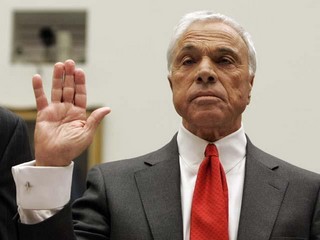
Yes grandchildren, the same man who rejects the word compromise, yet voted yes to an Iraq Shock and Awe (while voting yes to make the Bush tax cuts permanent), will not let his buddies to pay for Shock and Awe (a.k.a. pass it along to the grandchildren), is tightly bound to his lobbyist friends, votes yes to bail out banks via TARP, and then drafts a budget that removes $850 billion (6% of our current deficit) off your back over 10 years. This is the same Mr. "reject compromise" that grew up in a family of 12 children (including sisters) with one bathroom.

Grandpa remains party agnostic. Take Harry Reid's budget for example...smoke and mirrors and he too does not care about what debt ultimately ends up on the backs of our grandchildren. Grandpa's bottom line (no pun intended): you can wrap a box full of dog poo in Red State paper or Blue State paper and it does not change the gooey mess in the box let alone the stench.
The Hill
By Erik Wasson
7/26/11
The Congressional Budget Office has told House Speaker John Boehner (R-Ohio) that his debt ceiling fallback plan will reduce the deficit by about $850 billion over ten years.
House GOP rank-and-file have been waiting eagerly for the score since they are worried the bill would not measure up to claims made about it by House leadership. Leadership on Monday said the bill would reduce discretionary spending by $1.2 trillion over ten years.
The CBO revealed the score in a Tuesday letter to the speaker.
The score is against the latest CBO baseline as adjusted to reflect the 2011 spending cuts deal between Congress and the White House that cut $38 billion in budget authority. Those 2011 cuts have ripple effects over the budget window.
The CBO has also determined that taking that earlier deal into account, the spending levels in the Boehner plan is a $1.1 trillion cut in the deficit.
Most of the effects of the Boehner plan come from caps it imposes on discretionary spending. Next year the cap is $1.043 trillion, a $6 billion drop from current levels.
Actual federal spending outlays in the ten-year period would be reduced by $710 billion relative to that March baseline, CBO says, if the discretionary spending caps in the Boehner plan are instituted.
Overall, savings in discretionary spending is cut $695 billion, mandatory spending is cut by $20 billion, and the savings in interest equals $135 billion.
CBO also looked at other more minor provisions in the Boehner bill. One would provide extra funding for Pell Grants to students and this costs $17 billion, while another would limit other student loans saving over $30 billion.
The Boehner plan is a two-step process whereby the debt ceiling would be raised before Aug. 2 and then again next year.
The CBO score reflects part one of the process, which grants President Obama the right to request a $900 billion increase in the debt ceiling, slightly more than the amount CBO says the Boehner plan cuts from combined deficits compared to the March baseline.
Boehner this spring said Congress would only raise the debt ceiling if spending cuts exceed the amount by which the debt ceiling is raised.
CBO does not assign a score to the second phase of the Boehner plan which would require a joint committee to come up with a plan to cut $1.8 trillion from the deficit by Nov. 23.